

Developer Pages on The Tie Terminal Just Got a Major Refresh

Developer activity is one of the most important and misunderstood signals in crypto. Most investors rely on surface-level metrics like commit counts or contributor totals to evaluate project health. These can be directionally useful, but often miss the underlying dynamics that actually matter. A project can appear active while losing its most experienced developers. Another can look small while steadily building a deeply committed, full-time contributor base. To address this, we have redesigned and expanded our developer pages for each coin on The Tie Terminal.
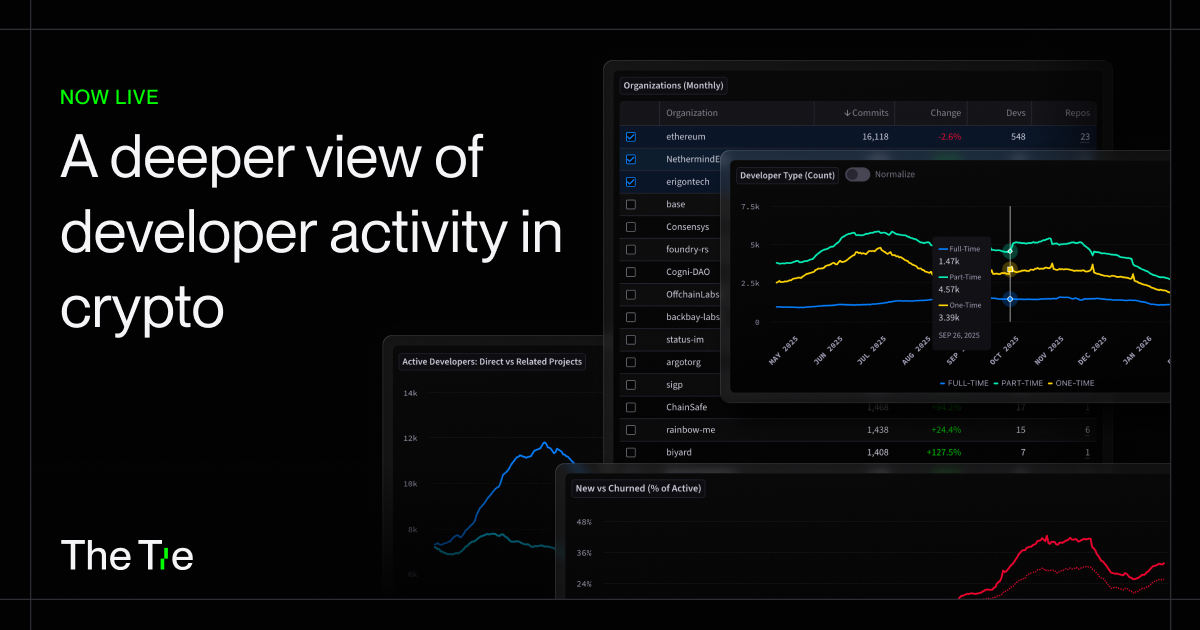
The refreshed Developer Pages on The Tie Terminal provide a structured, multi-dimensional view of developer activity across crypto networks covering contributor trends, codebase momentum, and talent migration, all benchmarked against market-wide averages.
Who This Is For
- Institutional Investors and Traders
Identify signals of ecosystem strength or weakness by tracking how developer activity is evolving beneath the surface. Shifts in contributor growth, retention, and concentration can provide forward-looking context that is not captured in price alone. - Venture Capital and Research Teams
Evaluate the durability of a project’s technical foundation. Understanding whether a network is attracting and retaining developers can help inform long-term investment decisions and differentiate between short-term hype and sustained growth. - Founders and Protocol Teams
Benchmark development activity against peers and the broader market. This can help teams understand where they stand, identify gaps, and track how their ecosystem is evolving over time. - Analysts and Strategists
Incorporate developer data into broader research frameworks. By combining contributor dynamics, codebase growth, and talent flows, this data provides an additional lens for evaluating network health and competitive positioning.
Customized Narratives
Developer data can be difficult to interpret, especially for those without a technical background. Even for experienced users, understanding a multi-dimensional story across many variables can be a headache.
To address this, each section of the Developer Pages includes a customized narrative that guides users through what’s happening in the data for a given project. These narratives are designed to reflect how The Tie’s data science team would interpret the trends at a high level, tailored to each individual asset.
This is the first time The Tie is rolling out this capability, and we see it as an important step toward making complex data more accessible and actionable across the platform.
What the Developer Pages Cover
1. Core Developer Activity Metrics
Understanding the health of a project’s developer base requires more than just counting contributors: it requires understanding how that base is evolving over time. Looking at total active developers in isolation can be misleading; what matters more is the underlying composition and direction of that activity relative to the broader market.
Breaking this down, the balance between new and departing developers provides one of the clearest signals of ecosystem momentum. Sustained periods where new contributors outpace churn typically indicate expansion, while the opposite can signal weakening engagement beneath the surface.
Equally important is the makeup of the contributor base itself. A growing share of full-time developers (i.e., those consistently contributing throughout the month) tends to reflect a more durable and committed core. In contrast, activity driven primarily by one-time or occasional contributors can point to more transient or incentive-driven participation rather than sustained development.
Together, these dynamics provide a more complete picture of whether a project’s developer ecosystem is truly strengthening, or simply appearing active on the surface.

2. Codebase Growth
While developer activity highlights who is building, codebase growth focuses on how much is being built and which teams are driving that work.
Commit volume over time provides a useful signal, but only when measured correctly. Raw commit counts can be inflated by noise such as merged forks or duplicated code. By filtering for original contributions and removing this noise, the data better reflects genuine development output and underlying momentum.
Looking more closely at which organizations are contributing adds another layer of insight. Development within an ecosystem is often concentrated among a small number of core teams. Tracking how contribution levels shift across these organizations helps reveal where momentum is building and which teams are gaining or losing influence over time.
Taken together, these perspectives move beyond simple activity measures. They help answer a more important question, not just whether development is increasing, but which teams are actually driving that growth.

3. Related Projects
Developer ecosystems do not exist in isolation. Talent moves across networks, and where developers choose to spend their time can provide important signals about competitive positioning.
Examining overlap between projects helps reveal how interconnected different ecosystems are and where developers are allocating their efforts. A high degree of shared contributors can indicate close relationships or competing areas of focus, while shifts in where developers re-engage after leaving a project can highlight where momentum is building elsewhere.
Looking at direct versus broader ecosystem activity adds another layer of context. Some networks rely heavily on adjacent projects to sustain overall development, while others maintain a more concentrated and self-contained core. Understanding this balance helps clarify whether activity is being driven internally or supported by a wider set of related efforts.
Together, these dynamics provide a clearer view of how talent flows across the landscape. For investors, this offers insight into ecosystem strength, competitive pressures, and where developer momentum is moving over time.

The updated Developer Pages are live now on The Tie Terminal. If you're not yet a user and want to see the pages in action, contact us to schedule a demo.