

[Recap] Beyond Payments: The Institutional Use Cases for Stablecoins

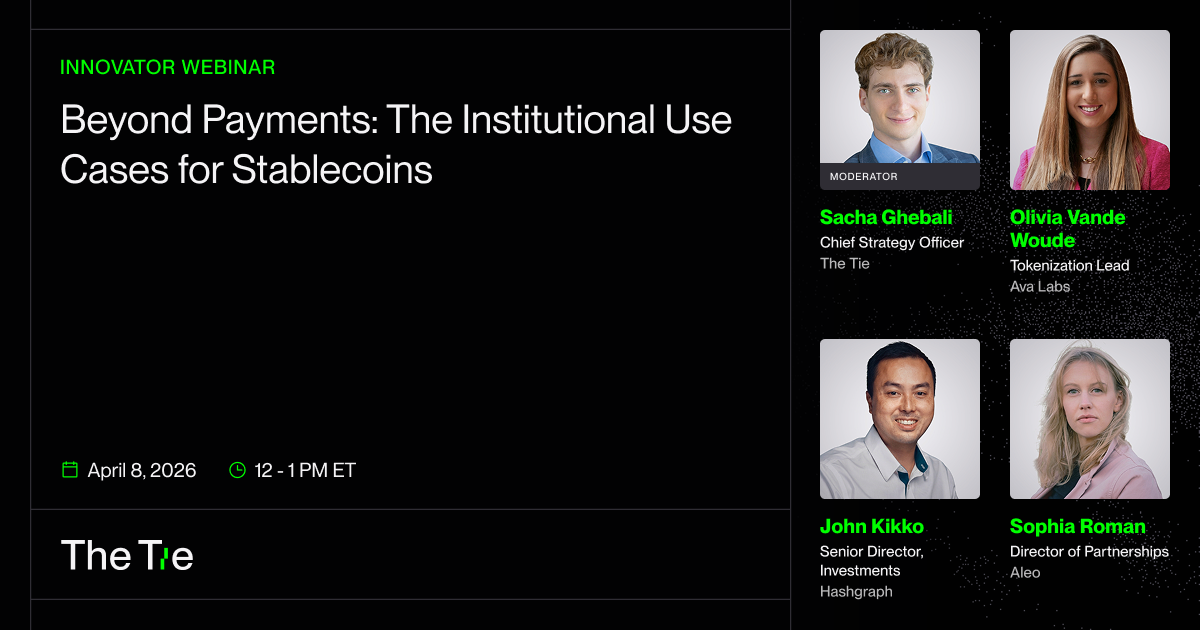
On April 8, 2026, The Tie hosted an Innovator Webinar on how institutions are deploying stablecoins beyond payments. Sacha Ghebali (Chief Strategy Officer, The Tie) moderated a discussion with Olivia Vande Woude (Head of Tokenization, Ava Labs), John Kikko (Senior Director of Investments, Hashgraph), and Sophia Roman (Director of Partnerships, Aleo).
Watch the full webinar here:
What Institutions Actually Mean by "Beyond Payments"
The dominant narrative around institutional stablecoins focuses on faster cross-border wires and tighter FX execution. The panel argued the more valuable opportunity is the internal coordination layer underneath all of that.
Global enterprises are sitting on trillions of dollars in liquidity trapped across subsidiaries, currencies, and jurisdictions. Intercompany payments between entities of the same corporate group can take three to thirty days to settle. Forty to sixty percent of treasury bandwidth goes to data collection rather than capital deployment. Faster external rails don't fix that.
John framed where product-market fit is actually emerging: find where large, predictable fees exist purely because of legacy payment infrastructure, and stablecoins tend to win. B2B travel payments were one example. A company called Xeni, deployed on Hedera, settles across multiple intermediary layers that would otherwise each carry credit card fees and reconciliation complexity whenever a booking is made or cancelled.
Use Cases Closest to Production
Olivia made the case for short-duration B2B financing and private credit as the highest-signal institutional deployment right now, even if it gets less airtime than tokenized funds or on-chain FX. The core argument: traditional private credit infrastructure is opaque, unstandardized, and constrained to weekly drawdown windows. Stablecoin-native rails turn the blockchain into a shared system of record for assets, repayments, and collateral, enabling programmatic draws and continuous covenant monitoring instead of periodic reconciliation. She pointed to a live facility running on Avalanche with OatFi and Valinor as a working example, with intraday borrowing and meaningful reductions in both cost of capital and operational overhead versus traditional rails.
John pointed to a Reserve Bank of Australia CBDC pilot on Hedera's private network, where after years of testing it is now accelerating toward production with both a central bank-to-bank and bank-to-consumer leg.
Sophia highlighted confidential payroll, private B2B payments, and treasury movements as categories moving fast. Aleo's launches with Circle's USDCX and Paxos for USAD brought fully encrypted stablecoins to production, enabling private payments in under a second for roughly a cent. For institutions where public wallet visibility creates market signal risk or client confidentiality exposure, the controls are built into the protocol rather than added afterward.
Who Owns It and What Blocks It
No single department owns a stablecoin initiative. These decisions touch risk, technology, regulation, and treasury simultaneously. The CFO's office tends to be closely involved when the use case touches liquidity management or intercompany flows.
The most consistent blocker wasn't regulatory uncertainty or technology readiness, it was accounting treatment. How does this position appear on the balance sheet, and how do we book a settlement event? Deceptively administrative on the surface, but capable of stalling a program for months. Olivia noted that a single SEC FAQ clarifying haircut treatment for payment stablecoins on broker-dealer balance sheets was enough to unlock programs that had been stuck in legal and finance review for months.
Capital Markets Infrastructure
For tokenized funds and capital markets workflows, Olivia outlined what a credible delivery-versus-payment model requires. Finality first, because on-chain settlement has no central counterparty absorbing principal risk. Then permissioning and identity, with token standards that bake jurisdiction limits and AML screening directly into the instrument. Privacy alongside that, so institutions can hide balances and transfer amounts from outside observers while giving regulators selective decryption access on demand. And interoperability to determine whether a DVP model stays bilateral or scales into a network.
ANZ's deployment of its own Avalanche layer-one for atomic cross-chain DVP settlement across Avalanche and Ethereum, with FX conversion between tokenized dollar stablecoins handled programmatically, was cited as a working production example.
Privacy, Compliance, and Selective Disclosure
Sophia described Aleo's approach: nothing is revealed by default. Sender, receiver, and amount are all private. ZK proofs ensure any disclosed data is verifiably correct, and the holder controls what gets shared, with whom, and for how long. She also made a less obvious point about market integrity. When on-chain wallet movements get read as directional signals by other market participants, institutions can hedge the resulting price impact off-chain. Retail investors absorb the cost of that misreading. Privacy protects investors as much as institutions.
The panel's broader conclusion on compliance: the right architecture is programmable infrastructure. Token standards that bake transfer restrictions into the instrument, compliance that executes as a precondition of settlement rather than a downstream review, and selective disclosure built into the protocol. Travel rule compliance across jurisdictions remains a gap that institutions need to solve at the execution layer, not treat as a reporting function.
Looking Ahead
Sophia pointed to defense tech and government banking infrastructure as an emerging category, with early movers beginning to stand up banking on crypto rails.
John flagged HederaCon on May 4 in Miami, where Hedera Council members will be showcasing live stablecoin use cases and demoing trustless interoperability solutions. He also noted that true, scalable interoperability, rather than bespoke one-off integrations, will be critical as stablecoins expand across networks.
Olivia highlighted two areas: embedded finance infrastructure from companies building programmable payment and yield primitives on Avalanche accessible to fintechs and neobanks via API, and private credit earning its institutional reputation through live performance data. Every month a production track record compounds, it builds the data set allocators need to take on-chain private credit seriously as an asset class.
The thread across all three: the next phase of stablecoin adoption will be defined by execution. Infrastructure that is invisible to the end user, compliance that is programmed rather than bolted on, and use cases where the economics speak for themselves.