

[Recap] Bitcoin 2.0: Token Standards, Rollups, and Infrastructure Layers
By

Reilly Decker
January 12, 2026
January 12, 2026
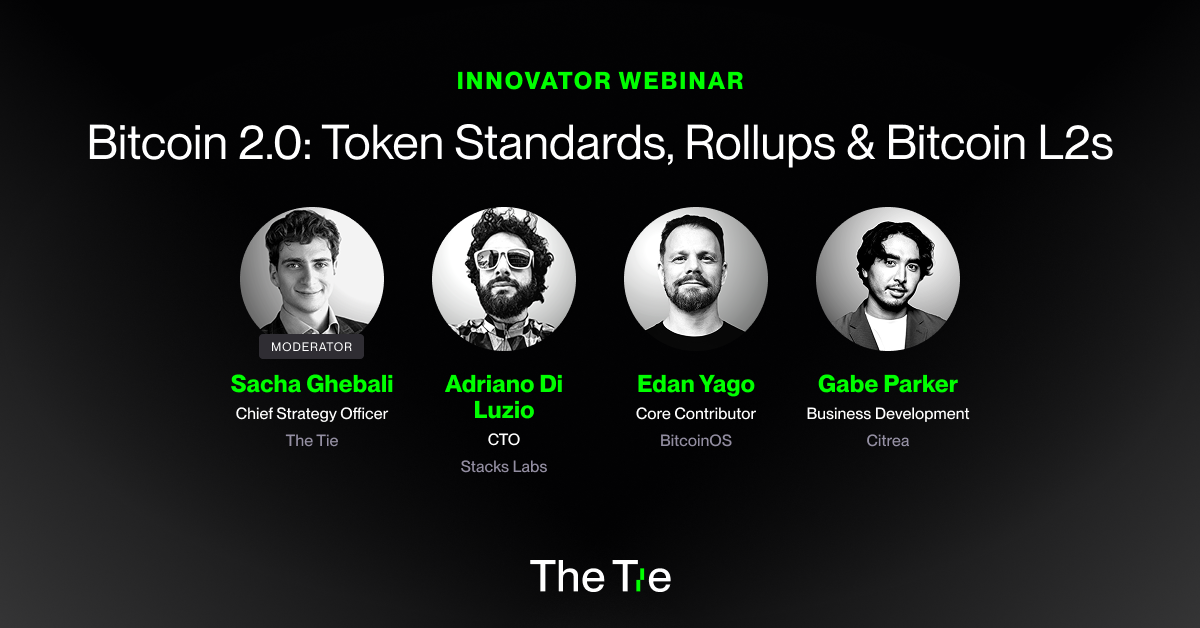
On January 14, 2025, The Tie hosted an Innovator Webinar titled “Bitcoin 2.0: Token Standards, Rollups, and Infrastructure Layers,” featuring Edan Yago, Core Contributor at BitcoinOS; Adriano Di Luzio, CTO at Stacks Labs; and Gabe Parker, Business Development Manager at Chainway Labs & Citrea. Moderated by Sacha Ghebali, Chief Strategy Officer at The Tie, the discussion explored how Bitcoin is evolving beyond simple value storage, and whether new execution layers, rollups, and cryptographic systems can meaningfully expand Bitcoin’s role in global finance.
Bitcoin Layer 2s: From Passive Asset to Productive Capital
The conversation opened with a shared view that Bitcoin Layer 2s are ultimately about making BTC productive without undermining its core security guarantees. Bitcoin’s conservative base layer has proven resilient as a settlement network, but its limited expressiveness constrains lending, stablecoins, and more advanced financial applications. Layer 2 systems and execution environments aim to extend Bitcoin’s utility while anchoring back to the base layer for trust and finality.
Panelists emphasized that durability matters more than speed. Systems that rely on fragile trust assumptions or permanent intermediaries are unlikely to gain long-term traction with Bitcoin-native users. Instead, credible roadmaps toward verification, proof-based security, and reduced reliance on trusted third parties are what distinguish meaningful infrastructure from short-term experimentation.
Programmability and the “Catch-Up” Phase
Edan Yago framed Bitcoin’s current evolution as a period of catch-up growth. Bitcoin already has unmatched liquidity, brand recognition, and human capital, but has been isolated from the broader application layer innovations seen elsewhere in crypto. As programmability improves, the near-term opportunity is to bring familiar primitives (DeFi, stablecoins, privacy, and cross-ecosystem integration) onto Bitcoin at an accelerated pace.
Adriano Di Luzio positioned Stacks as an execution layer built specifically to navigate Bitcoin’s constraints. While Bitcoin’s conservatism limits iteration at the base layer, Stacks is designed to evolve faster while maintaining tight alignment with Bitcoin’s security model. The long-term goal, he noted, is to enable users to deploy BTC in DeFi without effectively surrendering custody or relying on opaque bridging mechanisms, even if that path requires incremental trust minimization rather than immediate perfection.
ZK Rollups and EVM Compatibility
Gabe Parker highlighted that zero-knowledge technology is often misunderstood as purely a privacy tool. In practice, ZK rollups deliver compression, batching, and lower fees, making high-frequency and complex applications feasible in a Bitcoin-adjacent environment. By anchoring rollups to Bitcoin, these systems aim to inherit Bitcoin’s security while enabling faster execution.
Citrea’s EVM compatibility reflects a more modular approach. Rather than reinventing DeFi primitives, Bitcoin rollups can import proven applications from Ethereum. Parker argued that many DeFi use cases are already well understood, and lowering the barrier for existing teams to deploy on Bitcoin is a faster path to adoption than building entirely new paradigms from scratch.
Token Standards and Bitcoin-Native Assets
A major theme was whether new token standards on Bitcoin represent durable innovation or speculative noise. Yago noted that until recently, truly programmable tokens were not possible on Bitcoin in a meaningful way. With new protocols enabling on-chain programmability, Bitcoin is beginning to support familiar constructs such as governance, coordination, and asset issuance.
That said, the panel drew a clear distinction between experimentation and structural demand. While Bitcoin may host the full spectrum of tokens over time, stablecoins and Bitcoin-backed financial instruments were repeatedly identified as the most important long-term drivers. With trillions of dollars in BTC value and growing demand to borrow against it, stablecoin issuance and BTC-backed lending stand out as the most natural extensions of Bitcoin’s role as a financial asset.
Security, Language, and User Trust
The panel moved to discussing security models and how they are communicated to users. Di Luzio acknowledged that explaining Layer 2 security remains difficult, especially when users must reason about execution layers, bridges, and different trust assumptions. Over time, the panel expects proof-based systems to simplify this landscape by making infrastructure verifiable rather than trust-dependent.
Yago argued that the industry’s language itself is often a barrier. Users are less concerned with abstract notions of “trustlessness” and more focused on practical outcomes such as protecting wealth, managing risk, borrowing efficiently, and operating across borders. Bitcoin’s promise as a hedge asset weakens if meaningful financial activity still requires reverting to traditional intermediaries.
Institutional Adoption: Lending as the First Wedge
When discussing mainstream adoption, the panel agreed that institutions have so far engaged with Bitcoin primarily as a store of value. The next phase, however, centers on usability. Bitcoin-backed lending emerged as the clearest entry point, offering a familiar financial product with immediate demand.
Parker noted that institutional conversations often begin with a single concern: the safety of BTC when moving across layers. Bridging remains the most scrutinized component, particularly for fiduciaries. Still, demand is building, and institutions are increasingly willing to explore on-chain strategies as infrastructure matures and security assumptions become easier to evaluate.
Looking Ahead: Integration Over Fragmentation
In closing, the panel emphasized that Bitcoin’s long-term success depends less on which specific layer or execution model “wins” and more on whether the ecosystem becomes more integrated rather than increasingly fragmented. Privacy, on-chain activity, and trust-minimized BTC usage were identified as key variables to watch over the coming years.
Rather than competing narratives, the discussion underscored a shared objective: expanding what Bitcoin can do while preserving the properties that made it the industry’s most trusted foundation. Whether through rollups, execution layers, or native programmability, the next phase of Bitcoin’s evolution will be defined by practical utility, credible security, and systems that scale without sacrificing trust.
Stay up to date
Sign up to receive an email when we release a new post
Thank you! Your submission has been received!
Oops! Something went wrong while submitting the form.