
[Recap] Growing Tezos Ecosystem with RWA Tokenization & Gaming

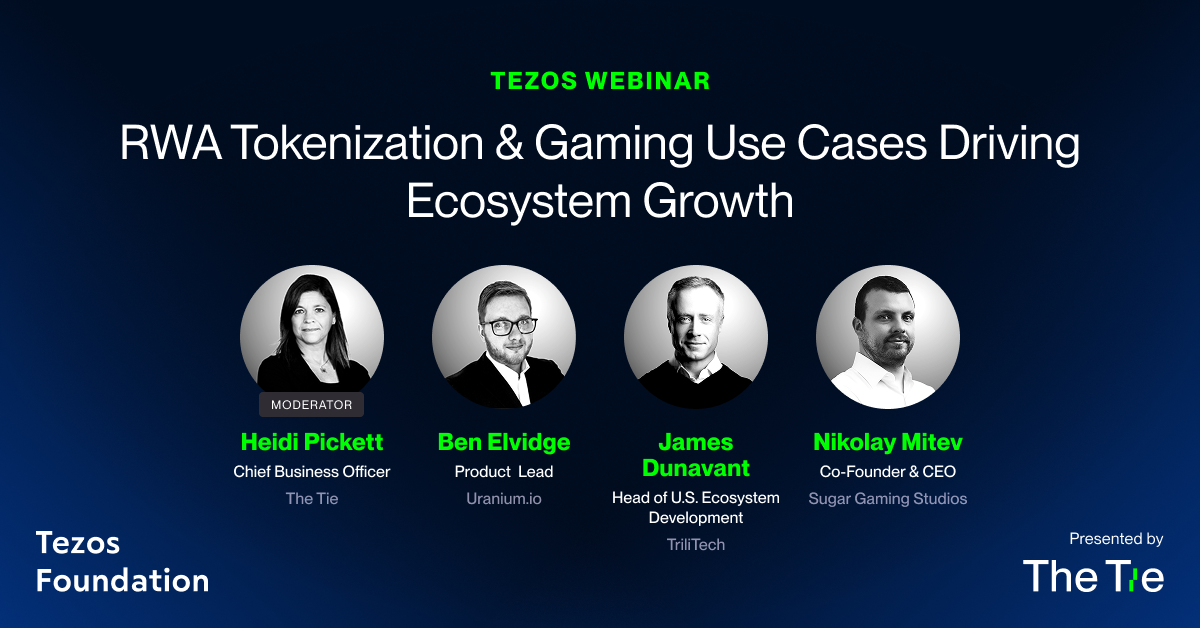
On January 8, 2026, The Tie hosted a quarterly call with Tezos focused on how real‑world asset (RWA) tokenization and gaming are helping grow the Tezos ecosystem, moderated by Heidi Pickett, Chief Business Officer at The Tie. The panel featured Ben Elvidge, who leads Uranium.io; James Dunavant, Head of U.S. Ecosystem Development at TriliTech; and Nikolay Mitev, CEO of Sugar Gaming Studios.
Across commodities and consumer apps, the conversation centered on a practical question: where is product‑market fit showing up today and what needs to improve (liquidity, UX, and regulation) to move from promising pilots to scalable adoption?
Watch the full Webinar here:
Tokenized Commodities: Collateral Utility First, Portfolio Exposure Next
Ben Elvidge argued that institutional product‑market fit in RWAs is still evolving, but the clearest demand today is tied to collateral efficiency and cash-like instruments. As tokenized finance infrastructure matures the near term wins are often less about novelty and more about better rails: improving how collateral is posted, managed, and reused. From there, Ben highlighted a second wedge he believes is poised to expand, particularly in commodities. Using uranium as a reference point, Ben described how tokenization can provide more efficient exposure than traditional options. He also pointed to how composability can unlock new behavior including using tokenized commodity exposure not only for diversification, but also as working collateral in on‑chain lending. He emphasized that a key diligence point is helping teams understand tokenized uranium as beneficial ownership of physical uranium with on-chain transfer rails, rather than a standalone crypto asset.
Gaming Adoption Depends on UX That Doesn’t Feel “Crypto”
For Nikolay Mitev, the path to mainstream Web3 gaming adoption is straightforward in theory and difficult in practice: make games that are fun first where blockchain is infrastructure and not the product. He framed gaming as one of the only categories where millions of users can touch on‑chain systems daily without thinking about it if the experience removes the moments that break trust or flow. A major focus was wallet UX. Nikolay called out friction points that still hurt consumer onboarding such as seed phrases, gas concepts, and network switching describing these as growth killers for mobile first products. He argued that when wallets feel like a background utility and tokens feel like in-game resources (not financial instruments), retention and monetization improve. He also pointed to Etherlink’s role in enabling low fees and predictable execution for high‑frequency actions that matter in live games. On sustainability, Nikolay emphasized economy design that is legible to users. He described a PvP structure inspired by proven mechanics in other industries: players enter matches with buy-ins, and rewards are funded through gameplay participation rather than unclear reward models. The broader point: sustainable game economies require clarity on where rewards come from and why they persist over time.
Tezos and Etherlink: One System for Builders, Two Paths for Adoption
James Dunavant positioned Tezos and Etherlink as part of a single, consolidated ecosystem: Tezos as the Layer-1 security and economic base, and Etherlink as the EVM‑compatible execution environment built as an enshrined rollup on Tezos. His emphasis was that ecosystem activity and economics should be viewed on a consolidated basis, particularly when comparing Tezos/Etherlink to ecosystems where L2s are controlled by smaller governance structures. From a growth standpoint, James emphasized that the goal is not to force one narrow thesis but to enable builders where Tezos is uniquely suited, particularly in categories like gaming and RWAs where infrastructure decisions directly influence distribution, cost, and reliability. He also spoke to the importance of access as a recurring theme for 2026: access to Tezos itself through more traditional channels, and access to historically hard‑to‑reach assets through tokenization.
The U.S. Window of Opportunity: Distribution and Institutional Confidence
A significant portion of the discussion focused on how shifting U.S. market structure and regulatory momentum could expand participation. James framed the U.S. environment as moving through a sequence from technology readiness, to regulatory guidance, toward clearer legislation and precedents that allow institutions to act with confidence at scale. He also noted that clearer frameworks can support stronger valuation approaches and governance comfort for large allocators. Ben added that regulatory clarity doesn’t just reduce uncertainty, it can reshape go‑to‑market strategy. Clearer rules influence who can participate, how products are distributed, and whether tokenized assets can move from experimental allocations into institutional workflows like collateral, margin frameworks, and secondary trading through more traditional channels. From the consumer gaming perspective, Nikolay underscored that U.S. rules of the road aren’t only government facing. App store constraints (particularly across Apple and Google) materially shape token design and in‑app mechanics. His view: more platform clarity and flexibility around in‑game token usage would reduce friction and eliminate the need for workarounds that make Web3 games harder to ship and harder to scale.
What Doesn’t Need Tokenization and What Comes Next
When the panel addressed the “tokenize everything” narrative, the discussion reflected a pragmatic range of views. Ben pointed to categories where tokenization can have limited utility, while Nikolay argued that exchange traded assets become meaningfully more efficient when tokenized. James framed tokenization as a longer term arc, with today’s priority being where it makes the most sense to start and scale responsibly.
Conclusion
Looking ahead, each panelist shared a forward view on what success in 2026 looks like. For Sugar Gaming Studios, it centers on fundamentals: active players, revenue, and sustainability. For Uranium.io, it is about expanding beyond a single asset into a broader commodities roadmap and proving tokenized commodities can scale into durable business models. For Tezos ecosystem growth in the U.S., James emphasized building channels, supporting credible builders, and expanding access with a focus on measurable increases in real, utility-driven on‑chain activity.
The discussion made a clear case that Tezos ecosystem growth in 2026 won’t be driven by narratives alone. The path forward is concrete: RWAs need institutional-grade liquidity and market structure, gaming needs consumer-grade UX, and both benefit from clearer distribution pathways as the U.S. environment evolves. Across the panel, the strongest signal was the same: the projects that win the next cycle will be the ones that feel useful, even when markets are noisy.