


Crypto's Developer Base Is Getting More Senior

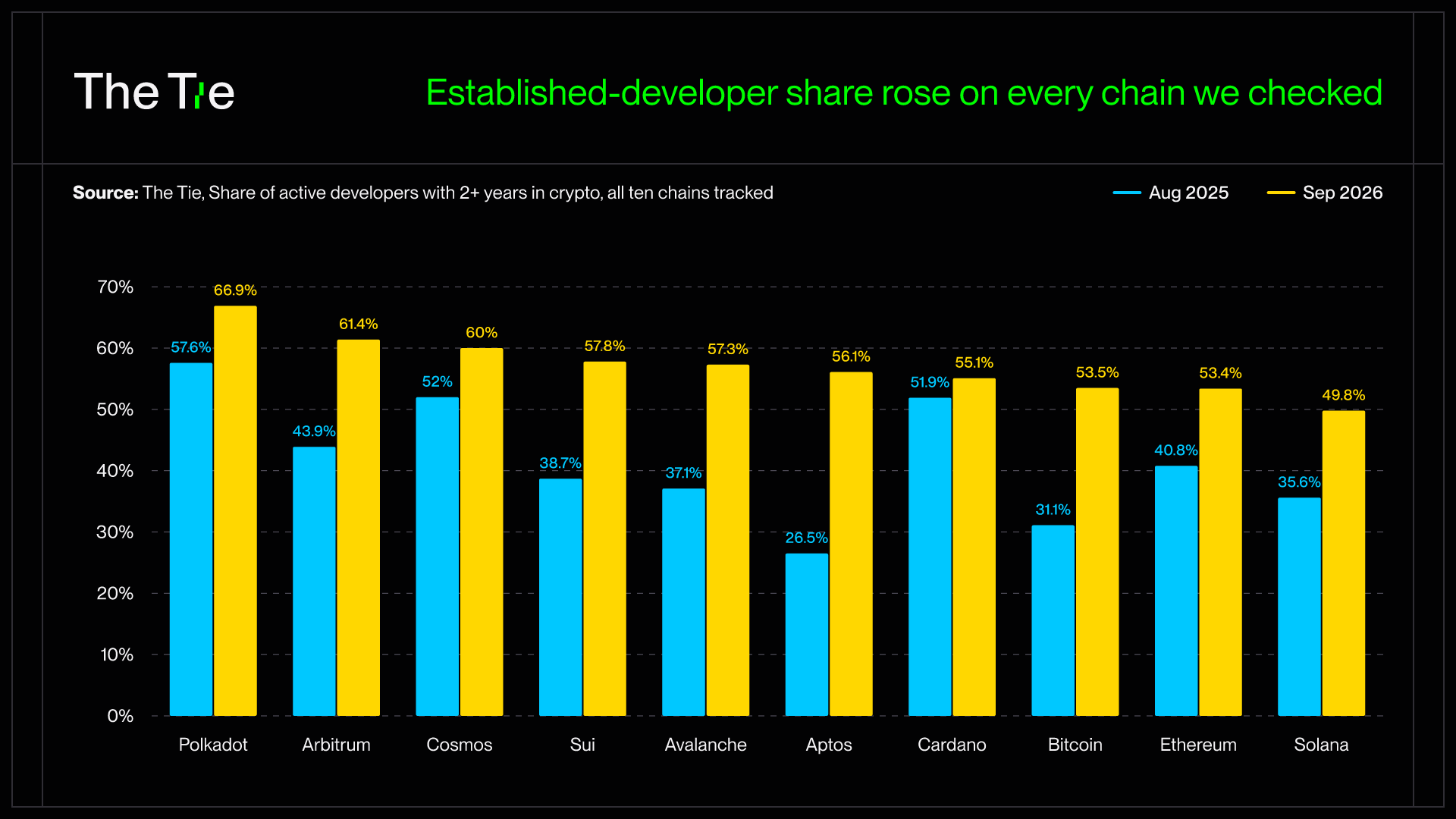
The developers still building in crypto are more experienced than they were a year and a half ago. The shift holds up under scrutiny. The share of active developers with two or more years in crypto has climbed since January 2025, across every major chain The Tie tracks and in the market-wide average across every coin we cover: from 47.0% to 51.1% market-wide. All ten major chains we checked show the same rise, no exceptions. (On a stricter alternate tenure definition, covered in the caveats below, nine of the ten still show it.)
That market-wide shift looks bigger if the comparison starts in August 2025 instead. Established share was down to 39.0% that month, an unusually newcomer-heavy point, before climbing to 51.2% now. That's a 12-point move, not 4. August 2025 was a trough, not a normal baseline. Newcomer share market-wide hit 47.9% that month, well above the January reading (39.5%) and today's (34.1%). The direction of the story doesn't depend on which start date you use. The size of it does. Both are worth stating plainly.
Chain by chain, the same pattern holds regardless of baseline. On Ethereum, developers with 2+ years of tenure were 40.8% of the active base in August 2025. They're 53.4% now. From January 2025 the move is smaller but still real: 47.3% to 53.4%. Solana moved from 35.6% to 49.8% since August, 39.6% to 49.8% since January. Bitcoin moved from 31.1% to 53.5% since August, the sharpest shift among the three largest ecosystems on that baseline. The rest of the ten chains we checked (Sui, Arbitrum, Polkadot, Aptos, Avalanche, Cardano and Cosmos) all moved the same direction on both baselines. The smallest move was 5 points (Cardano, since January). The largest was 18 (Sui, since January).
Total headcount for these ten chains fell hard over the same window. It's measured on the same basis as the tenure figures above, so the two comparisons describe the same population of developers. Cardano was the most resilient, down 22% since August 2025. Polkadot was next at 29%. Cosmos fell 47%, Bitcoin 50%, Arbitrum 51%, Ethereum 53%, Sui 57%, Solana 58%, Avalanche 65%. Aptos fell the most, down 69%.
Established developers didn't dodge that decline either. They just left far more slowly. Take the market-wide cohort of developers with two or more years of tenure who were active in August 2025. Only about a third of them (36.5%) were still active a year later. Newcomers fared worse: just 8.7% retained over the same window, four to five times as bad. The established population still fell by more than a third market-wide, roughly 37%, with Ethereum's established headcount alone down 40%. That retention gap, not a rise in veteran headcount, is what pushed the established share higher. Had newcomers held steady, veteran losses alone would have pulled the established share down by around 8 points. Instead, the newcomer collapse added roughly 17 points and veteran departures subtracted about 6, netting the market-wide rise. The senior cohort shrank by more than a third. The newcomer cohort shrank faster still. A rising share during an overall decline is only arithmetically possible when the smaller-declining group is established. That's what happened here.
A CoinDesk report this spring put crypto's overall decline at 75% in weekly commits and 56% in active developers, citing Artemis data over a different window than the one used here. It pointed to AI tools absorbing general programming talent as a contributing factor. It also reported that developers with two or more years of experience grew 27% year-over-year and now produce roughly 70% of all crypto commits. That's a commit-share and growth-rate claim on a different provider's data, not a share-of-the-developer-population claim on this piece's ecosystem-wide counts. It shouldn't be read as the same finding measured twice. It points the same broad direction, a more senior-weighted base, without confirming this piece's specific numbers. The Tie computes something Electric Capital does not publish: tenure as a share of the active developer base, daily, chain by chain. That's what makes the per-chain breakdown in this piece possible. What's actually driving newcomers away faster than veterans is genuinely unsettled. Research on whether AI coding tools help junior or senior developers more is mixed. Some studies find larger gains for less experienced developers, others find the opposite. This piece doesn't take a position on the mechanism. The pattern in the tenure data is the finding. The cause is still an open question.
For an ecosystem or protocol team, this changes how a grants or hackathon program should be scored. Newcomer retention over the past year ran at 8.7%, established retention at 36.5%. That's a real edge for veterans, but not a strong one in absolute terms. Converting a newcomer into a multi-year contributor draws from a smaller and leakier pipeline than the headline share suggests. Retention of builders already in the ecosystem is the higher-leverage lever for now. For an allocator running diligence on a chain, a falling developer count needs a tenure read before it goes into a thesis. Cardano and Polkadot lost the least overall, 22% and 29%. Aptos lost the most, 69%. For a token holder or treasury desk, a relatively more senior builder base is a near-term asset for shipping the current roadmap. The open question is how long a pipeline running at under 9% newcomer retention can keep backfilling it.
Two caveats, stated here next to the chain-by-chain numbers rather than buried at the end.
First, on tenure. This piece counts years active in crypto generally, not years on a single chain. A developer who moved from Ethereum to Solana counts as established on both. Count tenure by years on that specific chain instead, and the established share moves a lot: 16 to 27 percentage points, depending on the chain. Nine of the ten chains still show a rising established share on that stricter basis. Cardano's reverses. It's the one chain where the "every chain, no exceptions" framing depends on which tenure definition you use.
Second, on headcount. The counts used for the decline figures above are ecosystem-wide. They include a project's broader repo network, not just its core protocol repos. A narrower core-repos count shows steeper declines. Before comparing our headcount figure to one from another source, confirm which developer definition it's using.
The Tie tracks active, new, churned and tenured developers across chains, with history back to 2020, through the Data APIs and Terminal.
FAQ
Is crypto developer activity growing or shrinking in 2026?
Shrinking in headcount, on every major chain The Tie tracks. Declines since August 2025 range from 22% (Cardano) to 69% (Aptos), on The Tie's ecosystem-wide developer counts, measured on a consistent basis with the tenure figures. Established developers shrank too, about a third of them market-wide over the past year, but far more slowly than newcomers. Newcomer one-year retention ran at just 8.7%, against 36.5% for established developers. That retention gap is what pushed the established share of the (smaller) active base higher, on all ten chains checked. (Nine of ten on a stricter alternate tenure definition; see the caveats in the full piece.)
Why is crypto's developer base skewing more senior?
Because newcomer retention is running four to five times worse than established retention, market-wide. It's not that established developers are staying at a materially higher absolute rate. Only about a third of developers who had two or more years of tenure in August 2025 were still active a year later. For newcomers under a year of tenure, it was under one in ten. What's driving newcomers away specifically, including how much AI-tool adoption contributes, is not something this dataset can isolate on its own.
Which major crypto ecosystem has the largest active developer base?
Ethereum, by a wide margin among the major chains The Tie tracks, though its ecosystem-wide developer count is still down roughly half since August 2025.