

Tokenization Funding Quadrupled Its Share of a Shrinking Market in 2026

South Korea's Financial Services Commission set February 4, 2027 as the start date for the first phase of its tokenized securities market last week. Phase one covers institutional-only money market funds and private bonds, unlisted equities through trust structures, and publicly offered fractional-investment securities. The later phases, including stablecoin settlement onchain, carry no dates and wait on legislation still in the National Assembly. Korea is not first. Japan wrote security tokens into law in 2020, and the UK, EU, Switzerland and Germany have all published dated frameworks since. What is unusual is a statutory commencement date for a phased rollout, which is why phase one has a hard date and the rest does not.
The timing is worth reading against where crypto's own capital has been going, because the tokenization funding story this year is easy to misread, and the headline version of it is only half true.
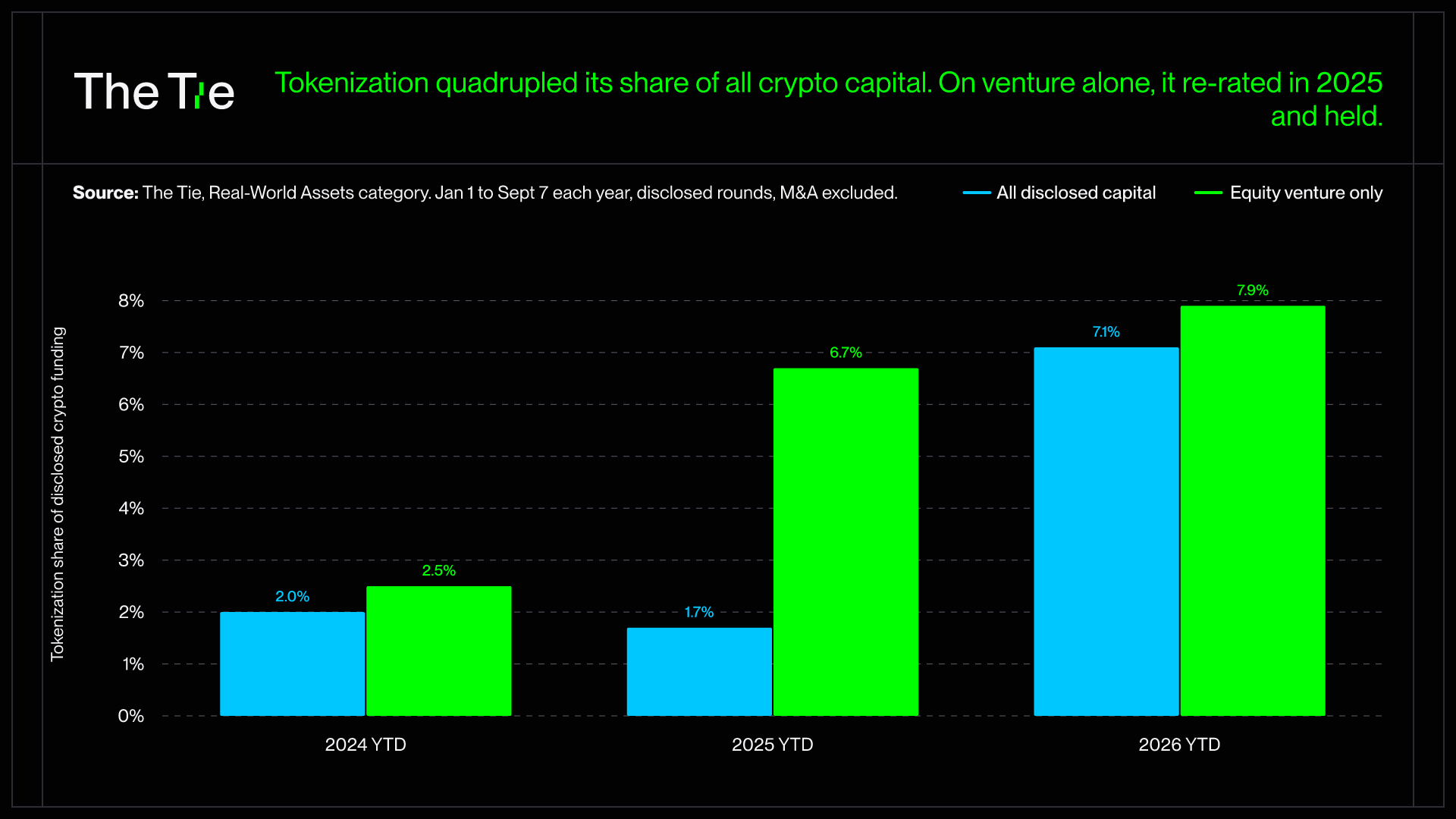
Companies tagged as real-world-asset businesses in The Tie's funding data raised $1.52 billion between January 1 and September 7, 2026. In the same window of 2025 they raised $836 million, and in 2024, $275 million. Dollars are up 1.8x on a like-for-like basis. Their share of all disclosed crypto funding went from 2.0% to 1.7% to 7.1%. That is the quadrupling in the headline.
Most of that move is the denominator. Total disclosed crypto funding in the January to September window fell from $48.5 billion in 2025 to $21.6 billion in 2026, and the collapse was almost entirely in financing that has little to do with venture. Debt went from $14.4 billion to $3.1 billion, PIPEs from $6.8 billion to $1.9 billion, post-IPO equity from $5.6 billion to $1.7 billion, and IPOs from $5.6 billion to $250 million. Treasury companies alone raised $16.4 billion in the 2025 window and $3.4 billion in the 2026 one. Split the share move into its parts and the shrinking market explains a little more than half of it; tokenization growing explains the rest.
Strip the denominator down to equity venture, pre-seed through Series F plus strategic rounds, and a different picture appears. Crypto venture funding did not fall this year. It rose 84%, from $6.0 billion to $11.1 billion. On that base, tokenization's share went from 2.5% in 2024 to 6.7% in 2025 to 7.9% in 2026. The re-rating happened last year, when venture investors nearly tripled tokenization's share of their crypto dollars, and 2026 has held that level while the venture pool nearly doubled underneath it. That is the actual finding: tokenization earned a bigger seat at the venture table in 2025 and kept it in a year when the other big 2025 stories, treasury companies and debt raises, evaporated.
The round sizes tell a similar story once they are measured properly. The median disclosed tokenization round was $3.0 million in 2024, $2.5 million in 2025 and $3.0 million in 2026. The typical deal has not changed. The mean of disclosed rounds rose from $5.4 million to $13.9 million to $19.8 million because of what happened at the ends of the distribution, not the middle. Rounds under $1 million went from 17 to 18 to 24, and rounds of $50 million or more went from zero to three to eleven. First-time raisers were 61% of this year's rounds, up from 40% a year ago. So both ends of the market opened up at once: more new companies got a first check, and a handful of established ones raised very large ones. Nobody is only backing operators over ideas. Seed activity rose.
The large deals are also more spread out than last year. The biggest 2026 round, Digital Asset's $355 million strategic, is 23% of the year's total; in 2025 OSL's $300 million post-IPO raise was 36% of it. Remove the ten largest deals from each year and tokenization funding still nearly doubles, from $179 million to $351 million, and its share of the market still rises from 0.4% to 1.6%. The increase does not depend on any one deal.
What the money looks like matters too. Roughly two thirds of 2026 tokenization dollars came from outside the classic priced venture round: $415 million in strategic rounds from balance-sheet investors, OSL's $200 million post-IPO placement, Tether's $150 million PIPE into Gold.com, Propy's $100 million credit line. That is how infrastructure gets financed, against balance sheets and strategic relationships rather than a venture thesis, and it fits a sector whose product is regulated market plumbing. It is not evidence that regulation caused the capital. Korea's enabling law passed in January 2026 and its phase-one scope was published on September 4, after the last round in this window; the 2024 and 2025 rounds predate it entirely. The timelines are arriving alongside or after the money, not before it.
On demand, US Treasuries are still the largest single slice of tokenized assets, about 45% of roughly $35 billion in non-stablecoin value outstanding as of late July according to rwa.xyz, but that share was 62% two years ago, and tokenized stocks have reached about $1.9 billion. Coinbase's tokenized equities on Base, DTCC's first production tokenized trades in July, from a service built with more than 50 firms, and Korea's phase one are the demand side broadening out. The funding data says the supply side got its capital first.
For an allocator, the quadrupling headline is not the signal. The venture-only share is, and it says tokenization re-rated in 2025 and has held near 8% of crypto venture since. For a founder, both ends of the market are open: first-time rounds are up and $50 million-plus rounds went from none to eleven, while the middle of the distribution has not moved in three years. For anyone tracking the sector, watch the venture share and the financing mix, not the share of a total that is mostly treasury companies and debt in one year and not in the next.
Three caveats. This measures capital raised, not tokenized value or usage. The category is a tag, not a business definition: it includes companies like OSL, Fasset and Gold.com whose primary business is not tokenization, and it excludes tokenization infrastructure rounds filed under other tags, Alpaca's $285 million across two rounds and RQD Clearing's $74 million among them. The two roughly offset. And late disclosures revise every year upward for months, so round counts are not comparable across years and dollar figures should be read as year-to-date, disclosed rounds only, with M&A excluded.
The round-level detail, by company and investor, sits in The Tie Terminal and the Data APIs.