

Most Token Unlocks Don't Move the Market

With Bitcoin near $80,000 and money moving back into crypto ETFs, attention has turned to the unlock calendar, and to investor cliffs in particular. That focus is mostly misplaced.
At least $21 billion of supply unlocked across 101 tokens in 2026 through August 19, valued at each unlock's price on the day. Investor allocations were $780 million of it, under 4%. The rest is scheduled emissions and treasury releases, and it is concentrated: Bitcoin mining (35%), Ripple's escrow (24%), WhiteBIT's treasury token (10%) and Solana (7%) make up 77% of the total.
Dollar size is the wrong lens
What moves a token is not the dollar value of an unlock but its size against the market that has to absorb it. Measured against average daily volume, almost every unlock is immaterial.
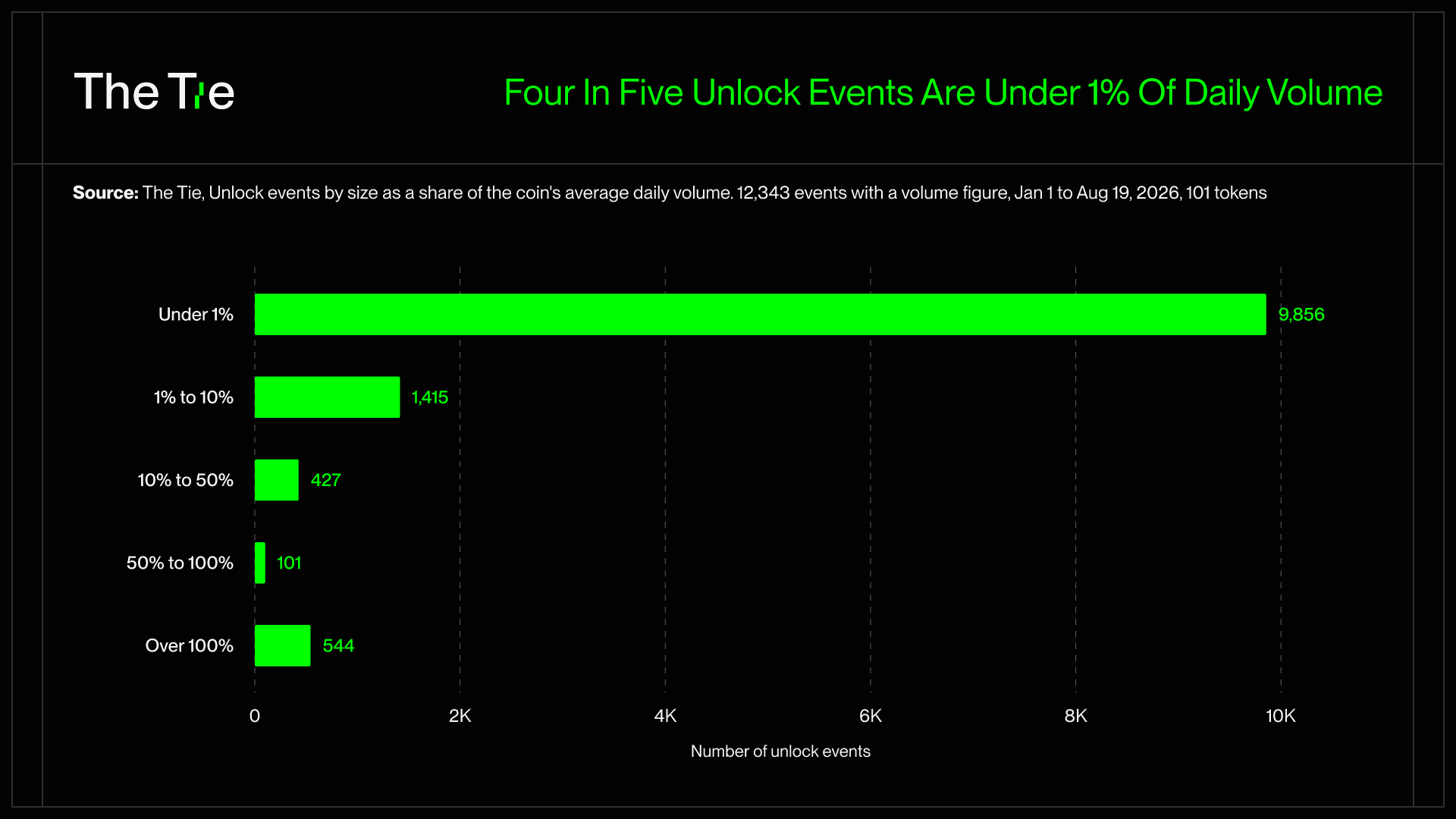
Across 12,350 priced unlock events, the median event was worth 0.20% of the coin's average daily volume, and 95.6% came in below a single day's volume. Bitcoin's daily issuance, the largest recurring line on the calendar, runs at a median of 0.09% of BTC's daily volume; Solana's at 0.13%. By dollars these lead the year. Against liquidity they are rounding error.
The tail that matters
Some 544 events exceeded a full day's volume, and most are small in dollars, a median of $189, concentrated in thin names like BendDAO, Lyra and Silo where volume has fallen faster than supply has grown. A screen on percent of volume alone surfaces these first, which is why it needs a liquidity floor underneath it.
Two events are the real signal. WhiteBIT released $2.19 billion of its treasury token in a single unlock, near 28x its daily volume and the largest single unlock event of the year by dollars. Ondo's two January unlocks landed at four and six times daily volume. What the liquidity lens changes is not that it finds these, but what it discards. Bitcoin's $7.4 billion of issuance and Ripple's $5.0 billion of escrow dominate any dollar-ranked calendar, and both clear well under a single day's volume every time. Ranked against liquidity, with dormant names filtered out, these are the two worth a second look.
Screening the calendar
The screen takes two cutoffs. Rank unlocks by notional as a share of average daily volume, then require both a liquidity floor of $30 million in average daily volume, which clears out illiquid names, and a size above a quarter of a day's volume, which clears out the immaterial ones. On the 2026 set that pair returns 27 events, short enough to read by hand, with the two that can actually move a market at the top.
This is not an argument that unlocks are irrelevant. It is that the variable is liquidity, not headline size. A billion dollars into a deep book and a few hundred thousand into a name that has stopped quoting are different events, and the dollar figure cannot separate them.
One note on scope. Counting mining issuance as unlocked supply is what puts Bitcoin at the top and holds the investor share near 4%; excluding emissions raises it to 6.9%, with the liquidity ranking unchanged. About a third of the total is scheduled to unlock after our latest data snapshot, so it is forward-dated rather than already realized, though both tail events above fall before the snapshot and are real. The set is the 101 tokens with priced unlocks in The Tie's data over the window, not the whole market, and share of volume measures scale, not realized price impact.
Methodology. An unlock event is one token on one date, summing every entity unlocking that day, which collapses 22,894 warehouse rows to 12,350 priced events; the 12,343 with a recorded volume figure are the base for the percentages here. Values are tokens released times that day's price. Average daily volume is the trailing 30-day mean on the unlock date. Investor allocations are unlocks typed as investment; the $335 million Alameda and FTX Solana Foundation sale is typed as an allocation and excluded, and counting it would lift the investor share to 5.3%. Schedules come from a May 7, 2026 snapshot.
Full unlock data, including forward schedules and holder detail, sits in The Tie Terminal and the Data APIs.