

[Webinar] Is Privacy-Preserving Infrastructure the Key to Institutional Adoption?

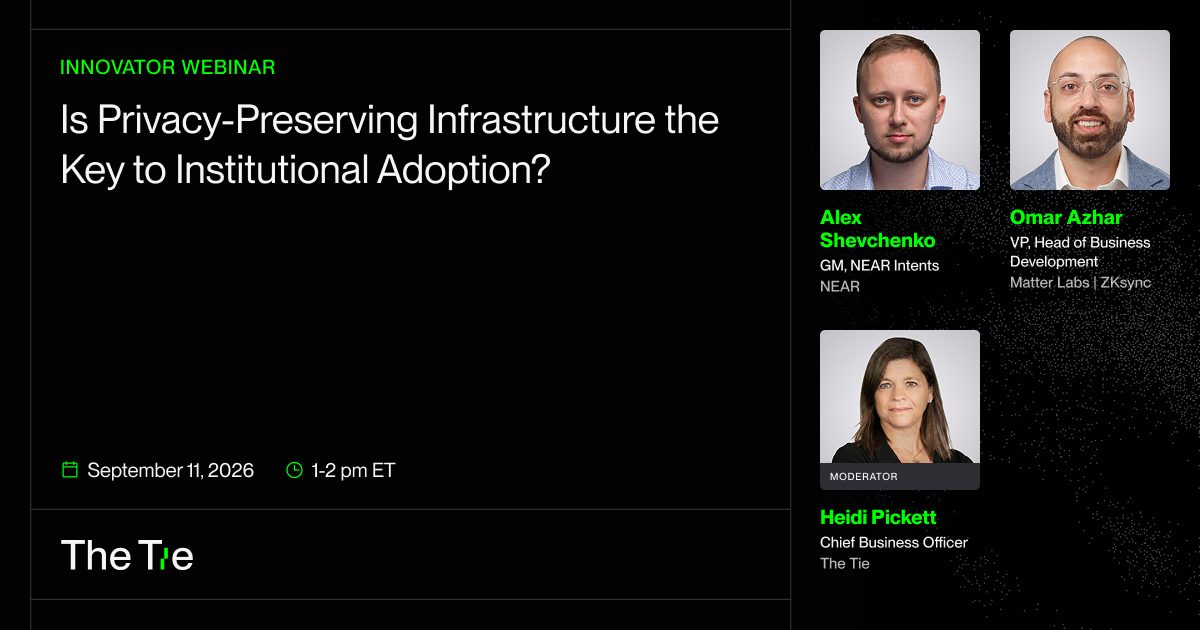
On September 11, 2026, The Tie will host an Innovator Webinar: "Is Privacy-Preserving Infrastructure the Key to Institutional Adoption?"
Institutional privacy infrastructure is moving from proof of concept to production. Omar Azhar's team at Matter Labs built Prividium, which lets an institution run a private chain within its own infrastructure while anchoring proofs to Ethereum. It's now running production deployments, including Cari Network, a multi-bank tokenized deposit platform backed by five regional banks. Alex Shevchenko's Confidential Intents at NEAR Intents takes a different approach, enabling private execution across networks rather than within a single institution's own environment, and reached general availability in July, already live in integrations like Infinex.
The harder question is what either model actually requires institutions to trust, and whether privacy is the real barrier keeping regulated capital off-chain, or a convenient explanation for legal uncertainty, fragmented liquidity, and operational complexity that would exist either way.
This discussion will examine what information institutions actually need to protect, where the line between confidentiality and transparency has to sit for markets and regulators to function, and what standards need to be in place before regulated capital moves on-chain at scale.
Speakers:
- Omar Azhar, Head of Business Development, Matter Labs
- Alex Shevchenko, GM, NEAR Intents
- Moderator: Heidi Pickett, CBO, The Tie
What we'll cover:
- Whether privacy is truly holding institutions back, or a convenient explanation for deeper barriers like legal uncertainty and fragmented liquidity
- What Prividium is and which institutional workflows require privacy and policy controls at the chain level rather than the application level
- What Confidential Intents enables, and whether the bigger opportunity is protecting individual transactions or persistent private workflows like treasury management and settlement
- Where institutions should draw the line between confidentiality and transparency for markets, auditors, and regulators to function
- What anchoring proofs to Ethereum lets an institution verify independently, and which risks remain with the private-chain operator
- Whether institutional privacy scales further through institution-controlled private environments or shared infrastructure with confidential execution
- How institutions can verify quote quality and reconstruct a trade for surveillance or dispute resolution when execution details are hidden
- Whether privacy and shared liquidity can coexist, or confidential execution inevitably fragments markets
- How institutions can prove sanctions, exposure, and access-control requirements were met without revealing the underlying parties or transactions
- What privacy-preserving infrastructure will need to do a year from now that it can't reliably do today
Join us live: