

How TradFi, Crypto-Native and Mainstream Media Cover Crypto

How TradFi, crypto-native and mainstream media cover crypto, Jan 2025 to Oct 2026
Why does news data matter?
Institutional market participants have used The Tie’s news data for years to make trading decisions. We have heard that funds consider different sources differently when they feed news into their trading models. That raises a simple question: how much do the sources really differ? The same asset or topic can be a front-page story in one place and barely mentioned in another.
This piece looks at how three groups of sources behave: how much they publish, and what they choose to talk about. The short version is that they behave very differently, and the differences line up with who the audience is.
What did we measure?
The Tie organizes publications into source groups. We looked at three common ones, from the beginning of 2025 to present.
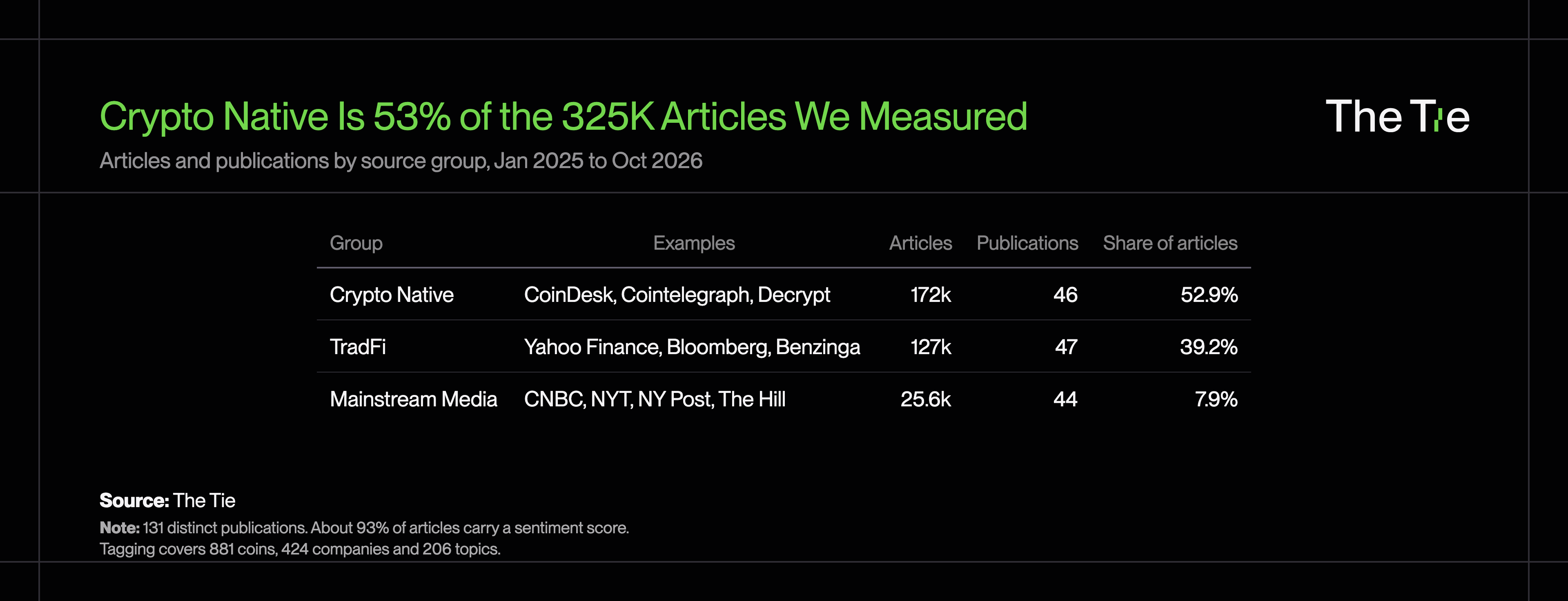
That is 324,650 articles from 131 distinct publications. The tagging covers 881 coins, 424 companies and 206 topics.
1. Do the three groups cover crypto in the same volume?
Crypto Native publishes the most by a wide margin: 1.4 articles for every TradFi article and 6.7 for every Mainstream Media one. The more interesting thing is how volume moves over time.
- TradFi coverage surged mid-2025 and then went back to baseline. A peak of 10,006 articles a month in October 2025, and about 4,500 a month again since April 2026.
- Mainstream Media followed the same arc at a smaller scale. About 780 a month, a peak of 2,464 in October 2025, and about 860 a month since April.
- Crypto Native held steady, then fell. About 9,000 articles a month in the first half of 2025, a peak of 10,190 in January 2026, and about 6,000 a month since April 2026, 30% lower. Some Crypto Native outlets stopped posting or wound down during the period, which accounts for part of the decline.

The trend makes sense. TradFi and Mainstream coverage peaked in October 2025, right around Bitcoin’s price high, and faded as the price slid toward its June 2026 low, so they look tied to the overall Bitcoin price. Crypto Native covers crypto either way.
2. Does Crypto Native still have higher sentiment, and is the gap closing?
We measure tone as net sentiment: the share of positive articles minus the share of negative ones. Over the whole window, Crypto Native has the highest sentiment, which is not surprising. We also look at sentiment by publication within each group and report some interesting results later in the piece.
Mainstream Media is mostly neutral (63% of articles). Negativity is similar for Crypto Native and TradFi (about 21%) and lower in Mainstream (15%), so the difference in tone is mostly about how many positive stories each group writes.
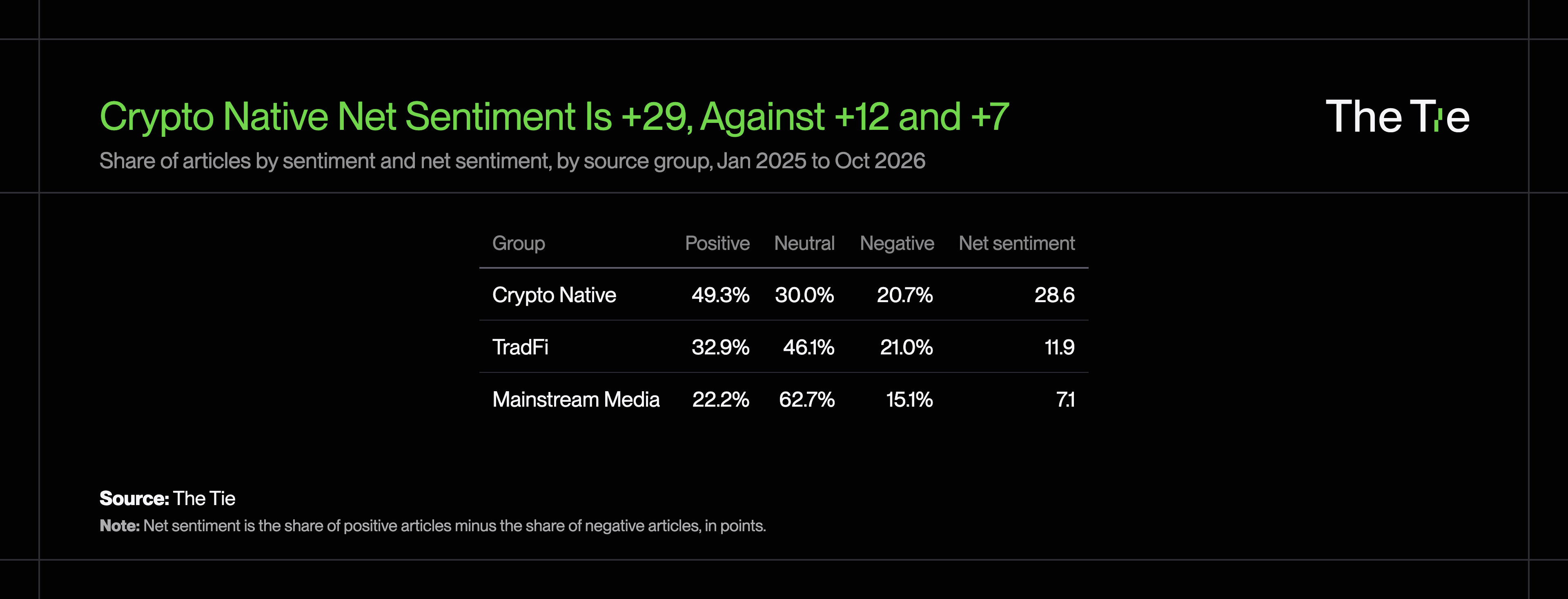
To see how the difference has changed, take Crypto Native’s net sentiment minus the average of TradFi and Mainstream, month by month.
- It started 2025 at +34 points and averaged +23 over the year.
- It held at about +18 points from January to July 2026.
- It fell to about +4 points in August and September, +3.1 in the latest month.

So Crypto Native’s lead held most of the way through 2026 and has narrowed sharply in the last two months. It would not be unfair to say that Crypto Native outlets, as a group, have become a little jaded in the current market context. We will keep watching how this evolves over the coming months.
Underneath, tone has fallen everywhere with the market. Crypto Native’s monthly net sentiment went from +42 in October 2025 to +6 in September 2026, while TradFi (+5) and Mainstream (+1) sit close to zero.
3. What does each group choose to cover?
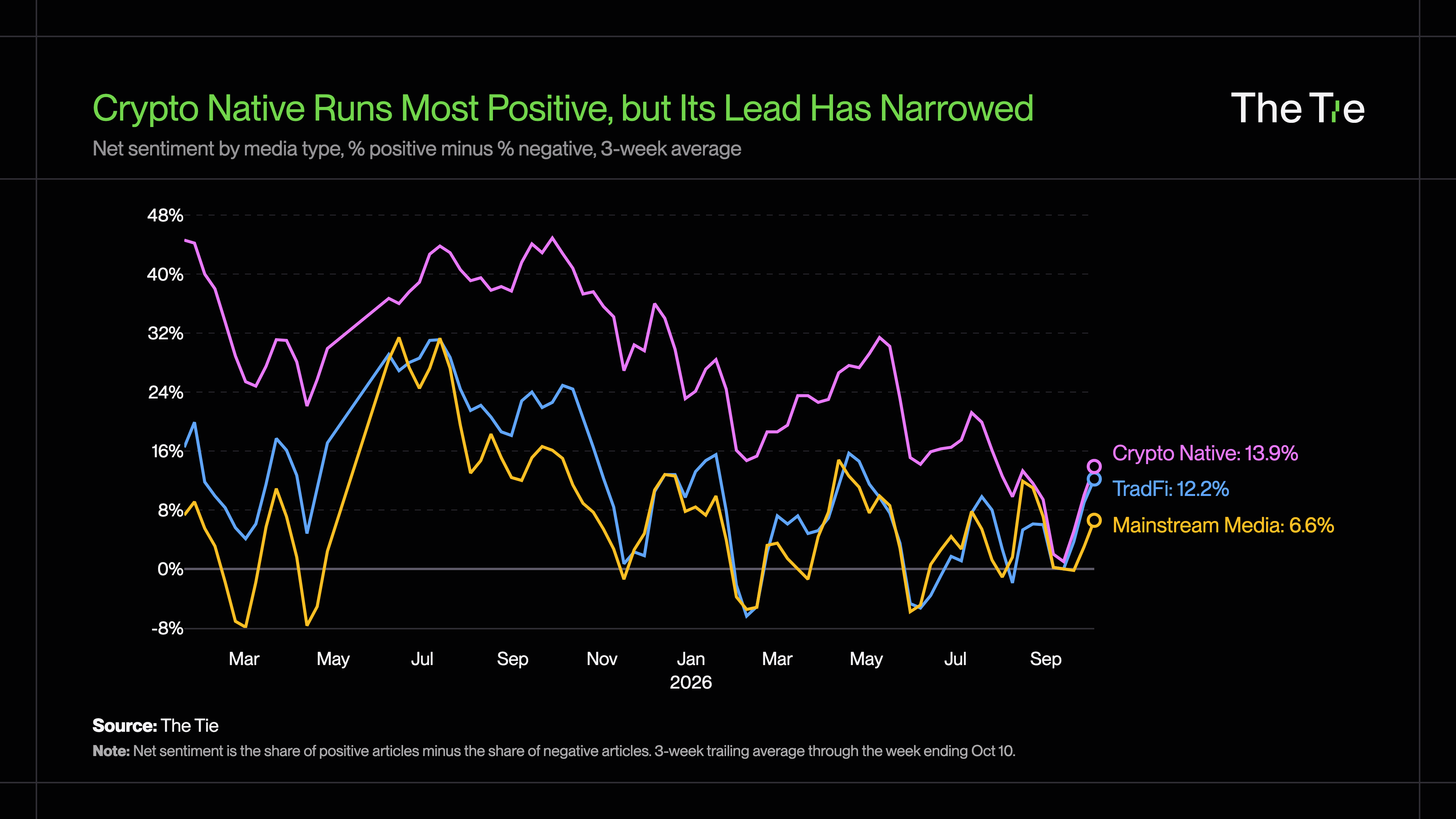
Groups also differ on what they talk about. We take each group’s share of its own mentions, then index that share against the average of the three groups. An index of +100% means a group gives a topic twice the share the average group does. An index of -50% means half.
Shares are of mentions, not articles, because an article can mention several coins or companies. Coin charts start Jan 2025. Company and topic charts start late in 2025 due to prediction markets surge as a topic.
Which companies get the most attention, and from whom?
Coverage sorts companies by who they are for.

- Ripple is a crypto-native story. 23.6% of Crypto Native’s company mentions, against 10.7% in TradFi and 1.0% in Mainstream. Mainstream media barely cover it.
- Kalshi is a mainstream story. 22.4% of Mainstream Media’s company mentions, against 4.9% in TradFi and 2.1% in Crypto Native.
- Strategy and Robinhood are TradFi stories. Strategy is 4.9% of TradFi mentions against 1.2% to 1.5% elsewhere. Robinhood is 9.7% against 2.2% in Crypto Native and 4.8% in Mainstream.
- Coinbase is mostly even everywhere. 10.2% in TradFi, 8.1% in Mainstream, 7.2% in Crypto Native. No group over- or under-indexes it by more than about 20%.
- Binance leans crypto native (9.9% there against 4.0% in TradFi and 3.3% in Mainstream).
Which topics?
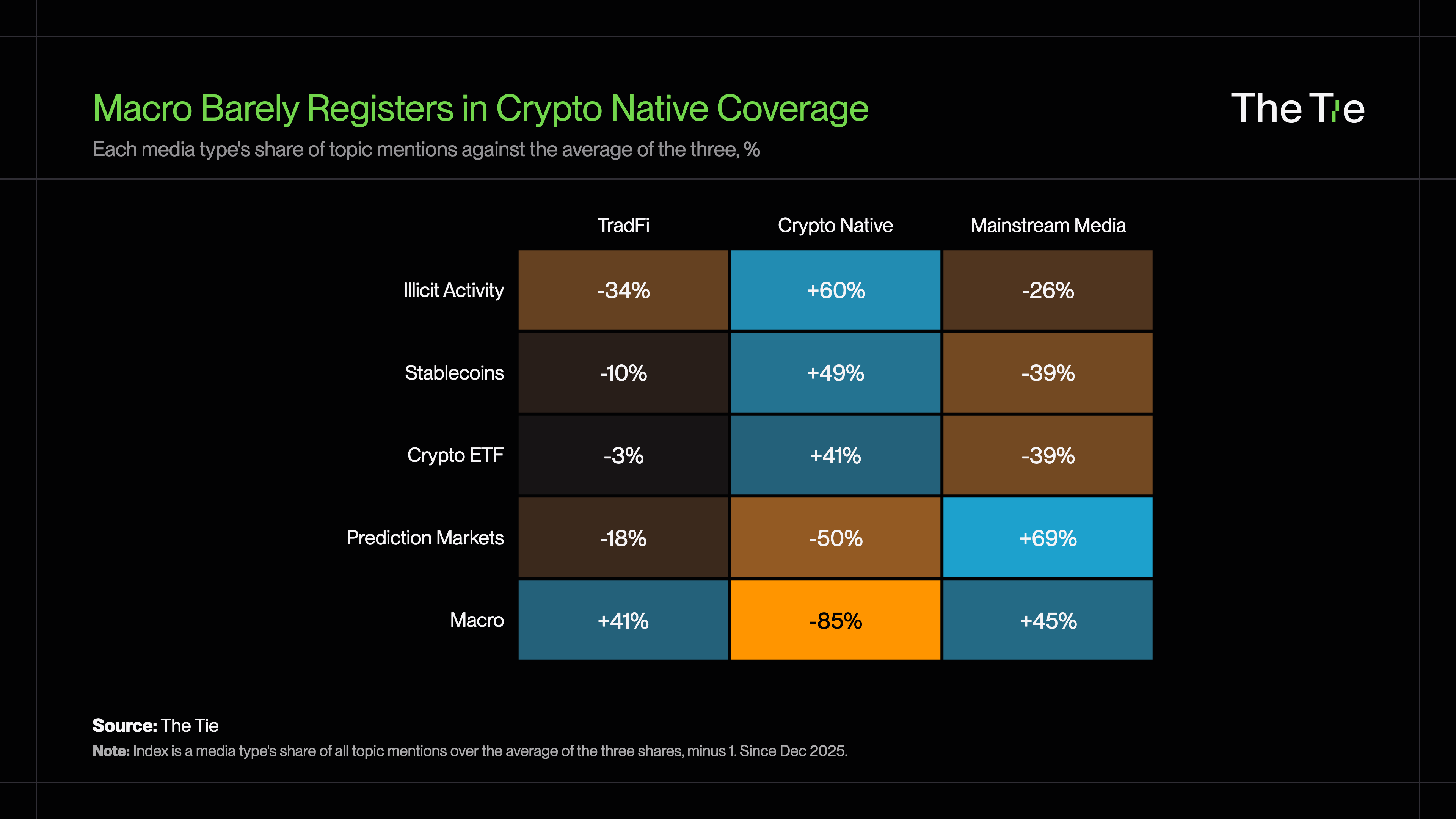
- Macro overweighted in TradFi and Mainstream Media. 22.0% of TradFi mentions and 22.6% of Mainstream, against 2.3% in Crypto Native.
- Prediction markets are a mainstream topic. 10.4% of Mainstream mentions, 5.0% in TradFi, 3.0% in Crypto Native.
Which coins?

- BTC is fairly evenly covered.
- XRP is covered like a major in TradFi (10.9%) and Crypto Native (10.5%) but almost ignored in Mainstream (2.1%).
- SOL, SHIB and HYPE are crypto-native coins. SHIB is 3.4% of Crypto Native coin mentions and 0.1% of Mainstream.
- DOGE is the mainstream favourite among the coins we picked: 6.8% of Mainstream mentions against 2.9% in Crypto Native.
4. Do outlets within a group sound alike?
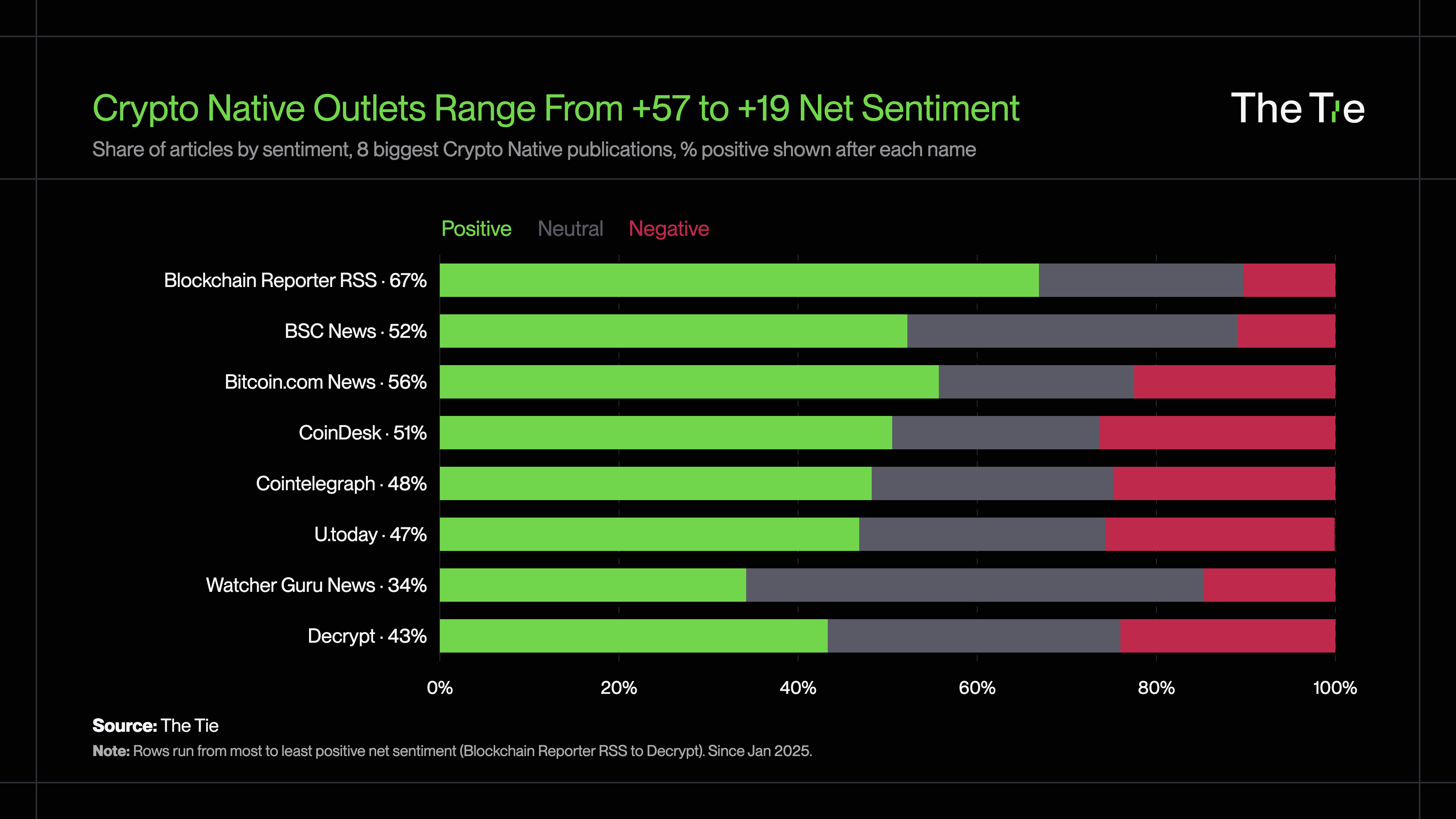
Even within a group, the tone of coverage can be quite different. We have measured sentiment at the publication level as well, for the 8 biggest publications in each group.


- TradFi spans 39 points of net sentiment, from Invezz (+32.5) and Benzinga (+18.1) down to Zerohedge (-6.2). Yahoo Finance, the biggest by far with about 60,000 articles, sits at +15.4.
- Crypto Native spans 37 points, from Blockchain Reporter RSS (+56.6) to Decrypt (+19.3). CoinDesk (+24.1) and Cointelegraph (+23.4) sit in the middle of the pack.
- Mainstream Media spans 55 points, and it is really two groups. Investing.com (+45.5) and Seeking Alpha (+31.1) read like crypto-native outlets. General news outlets are mostly neutral and a little negative: the New York Post is 88.5% neutral and -6.0 net, The Hill -7.6, the New York Times -9.4.
The practical point: “mainstream sentiment” depends heavily on which mainstream outlets you include.
5. Does tone follow price?
We lined up weekly net sentiment with BTC’s price to see whether there is anything to write home about. We use TradFi here because its tone swings from negative to positive over the cycle, which makes the relationship easier to see. This chart goes back to January 2023.

TradFi tone was net negative in 80% of weeks in the first half of 2023, averaging -22 points, the crypto winter. It turned mostly positive as BTC recovered: only 31 of the 161 weeks since July 2023 were negative. It averaged +17 in 2024 and +17 in 2025, then cooled to +5 in 2026 as BTC fell. In the eight weeks around BTC’s high (week of Sep 28, 2025) it averaged +22, against +2 around the low in June 2026, after BTC fell about 51%.
What does this mean?
- Where a company or asset sits in the three groups is a quick read on its narrative. Ripple is a crypto story, Kalshi a mainstream story, Strategy and Robinhood TradFi stories, Coinbase a story for everyone. A likely explanation is audience: each group writes about what its readers care about.
- The source matters. Traders consider where a story appears when they build models that use news data, because the same asset gets very different coverage and tone depending on who is writing.
- Attention from outside crypto comes in waves. TradFi monthly coverage rose 2.2x and Mainstream 3.2x from their first-half 2025 averages into the October 2025 price high, and both are back near those levels.
How did we do this, and what are the limits?
- Data. Articles from three Tie source groups (TradFi, Crypto Native, Mainstream Media) from Jan 1, 2025 through Oct 13, 2026. Weekly views end with the last complete week (Oct 10, 2026), monthly views with September 2026.
- Cleaning. We collapsed multiple feeds from the same publication into one name and did additional cleaning on our proprietary coin tags.
- Sentiment. Net sentiment is the share of positive articles minus the share of negative articles, using The Tie’s article-level sentiment. No sentiment scores exist for May 4 to 24, 2025 in any group, so May 2025 is blank in monthly views and weekly lines show a gap there.
- Volume. Every article from every publication in each group, counted by calendar month (complete months only).
- Shares and index. Share is a tag’s mentions as a percent of all mentions of that kind within a group. Index is that share divided by the simple average of the three groups’ shares, minus 1.
- Tag windows. Tags go live on different dates. We audit each selected tag and start the comparison when the latest one went live.
- What the groups contain. The groups hold all of a publication’s ingested articles, including general news, not only crypto stories. Only 30% to 54% of articles carry a coin tag.
- Price. BTC only, weekly closes, from The Tie’s market data.
This report is for informational purposes only and is not investment or trading advice. The views and opinions expressed in this report are exclusively those of the author, and do not necessarily reflect the views or positions of The Tie Inc. The author may be holding the cryptocurrencies or using the strategies mentioned in this report. You are fully responsible for any decisions you make; The Tie Inc. is not liable for any loss or damage caused by reliance on information provided. For investment advice, please consult a registered investment advisor.