

Hyperliquid Ranks Third Among Staking Markets by Value Staked

Hyperliquid holds $30.3 billion in staked value, which places it behind only Ethereum at $95.7 billion and Solana at $37.1 billion among proof-of-stake networks. It sits ahead of BNB Chain at $15.9 billion and Tron at $14.7 billion. The venue is known as a perpetual futures exchange, and it is one, but by the amount of capital committed to securing it, it ranks third among staking markets.
The figure matters this week because of what the venue is being considered for. President Trump said on August 19 that the Commodity Futures Trading Commission is working to bring Hyperliquid's perpetuals into the United States in a fully compliant fashion, and HYPE rose 19% that day. No approval, US entity or product list has been announced, and the remarks were not a regulatory filing. The same day the White House hosted a crypto summit pressing Congress on the CLARITY Act, which remains stalled in the Senate ahead of a September 15 procedural vote. If a US route does open, the counterparty on the other side of it is not an early-stage venue.
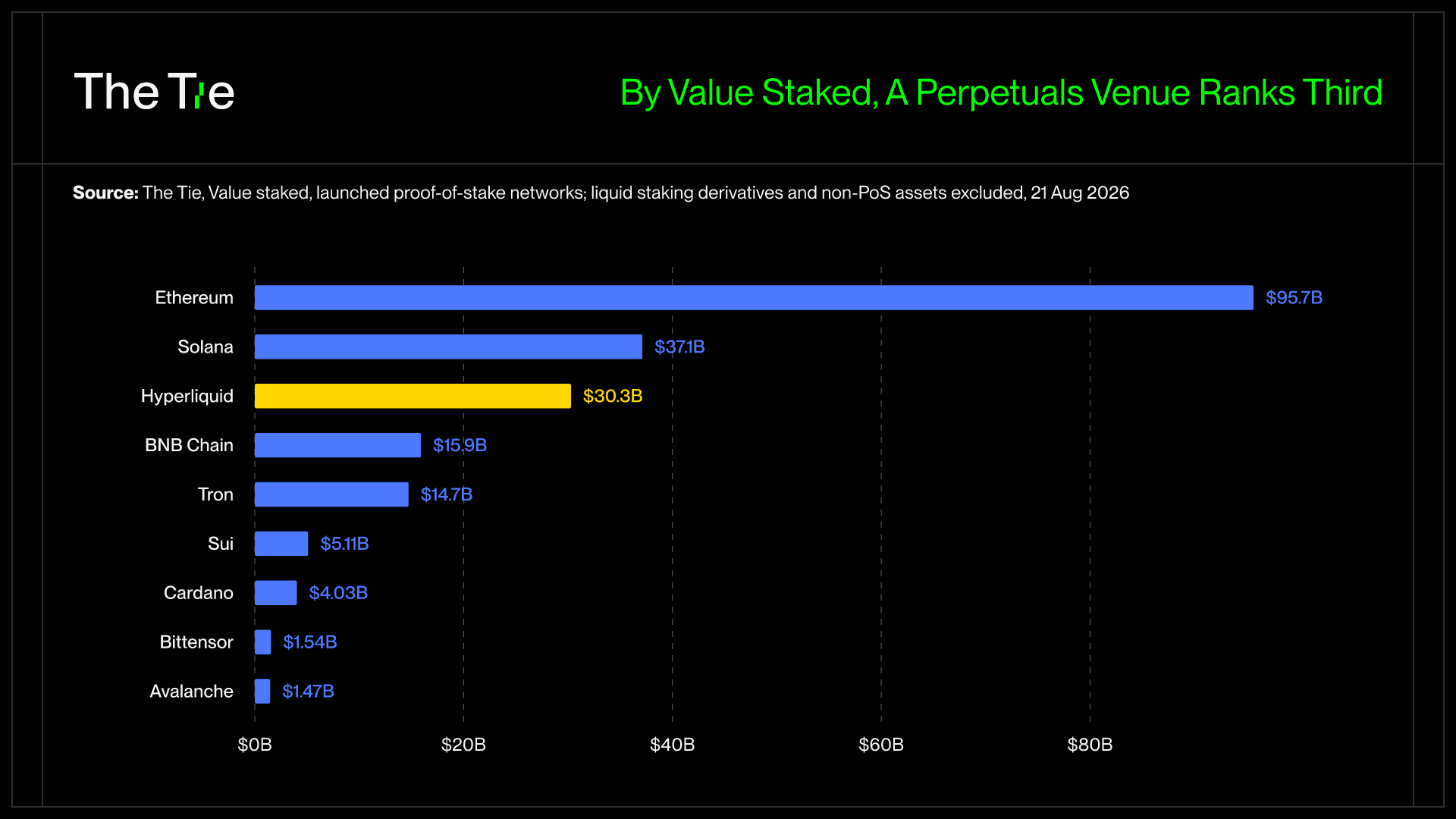
The size does not come from unusually heavy staking participation. Hyperliquid has 45.7% of its token supply staked, which is mid-pack: Bittensor runs 77.2%, Sui 72.1% and Solana 68.8%, while Ethereum sits at 35.0% and BNB Chain at 19.1%. Tron, at 46.5%, is almost identical to Hyperliquid. BNB Chain is the clearest case of the same mechanism running the other way: its token base is the second largest of this group at roughly $83 billion, but it places fifth by staked value because only 19.1% of that supply is committed. A network can reach a large staked base either by having most of its supply locked or by having a valuable token, and Hyperliquid is the second case. That distinction matters for anyone modelling how quickly that base could change, since a mid-range participation rate leaves room to move in both directions and a token-value-driven base reprices with the token.
One thing the data does not settle. Hyperliquid reports a 2.24% reward rate, but the dataset carries no issuance series for the network, so the real reward rate, meaning the reward rate adjusted for the network's new token issuance, cannot be computed the way it can for Ethereum or Solana. For a venue this size that is a genuine gap rather than a rounding issue, and it is the figure an allocator comparing staking exposures would want.
Two caveats belong on the comparison. Liquid staking derivatives are excluded, because tokens such as Lido's staked ether represent claims on assets already counted in their base network's total rather than separate markets. Including them would not change Hyperliquid's position, since the largest of them sits below $30.3 billion. Non-proof-of-stake assets are also excluded, which is why Bitcoin does not appear.
For an allocator, a venue of this size with no US regulatory wrapper is a different proposition from one with a wrapper and no size, and the ordering of those two events is the risk being priced. Staked value, participation and reward rates across networks are charted in The Tie Terminal, and the same series across more than 200 launched assets are queryable through the Data APIs.