


The SEC's Proposed Crypto Exemptions Would Cover Nearly Every Raise
The SEC has proposed two size limits for how crypto companies can raise money without registering a full securities offering. The Tie's fundraising data suggests both are set close to where the market already operates. Over the past year, 91% of disclosed crypto raises came in under $75 million, and 56% came in under $5 million.
The proposal, which the SEC calls Regulation Crypto Assets, opens two lanes. The first lets a company issue up to $5 million in tokens over four years, aimed at early-stage startups. The second allows up to $75 million a year, on the condition that the issuer files audited financials and reports on a regular schedule. Neither is law yet, and the broader market-structure bill, the CLARITY Act, is still stuck in the Senate. But the exemption thresholds are the part issuers will feel first, so they are worth checking against what crypto fundraising actually looks like.
The Tie tracks 1,298 crypto rounds with a disclosed amount over the trailing twelve months. Of those, 724 were $5 million or smaller, and 1,177 were $75 million or smaller. Only 121, about 9%, came in above $75 million. The smaller startup lane on its own would fit more than half of every disclosed raise, and the $75 million lane covers roughly nine in ten.
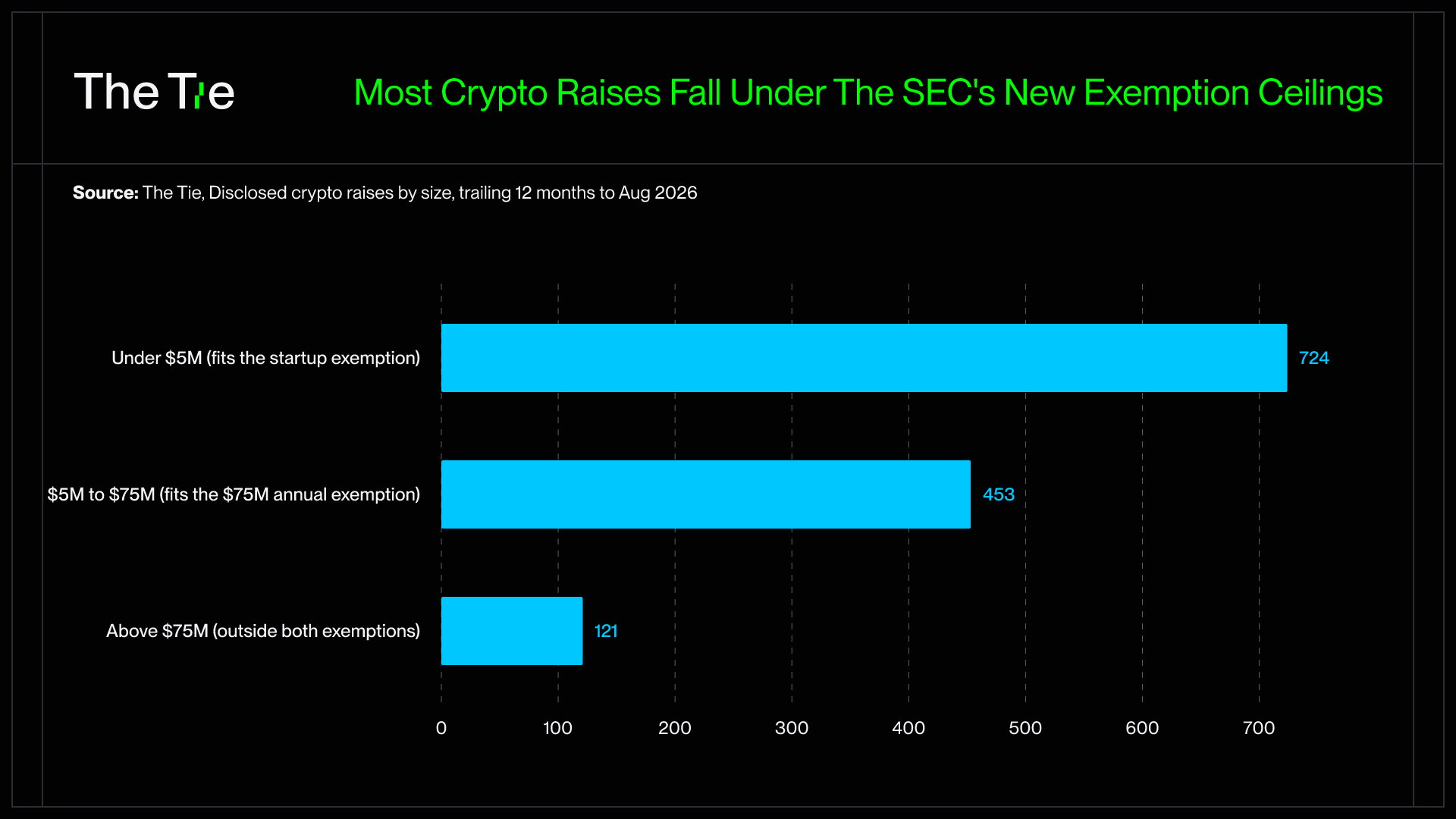
That result says more about the shape of crypto fundraising than about the SEC. The market skews early and small. Most rounds are pre-seed and seed checks written into companies that do not yet have a token, a product, or revenue, and a ceiling of $75 million was never going to bind that part of the market.
The raises that clear the ceiling are the unsurprising ones. Rounds above $75 million concentrate in the most capital-hungry corners of the industry: digital-asset treasury companies, exchanges, miners, and payment firms. These are businesses that raise nine and ten figures to buy coins, build data centers, or hold regulatory capital, and most already keep the legal counsel to run a private placement the traditional way. The exemptions were not really written for them.
For a founder, the read is simple. A framework whose limits capture most of the market is being drafted with the long tail of startups in mind, not the megadeals that make headlines. For an allocator, it is a hint about where regulatory friction will and will not sit as the rules firm up. Size is not the whole story. A raise still has to pass the underlying securities analysis before it can use an exemption, and a proposal can change before it becomes final. But the ceilings show who the SEC is drawing its lines around.
One caveat is worth stating plainly. These figures count only rounds with a disclosed dollar amount. A large share of crypto raises are announced without a number and sit outside this sample, so the real totals are higher than what is measured here.
The Tie tracks every crypto fundraise by size, stage, sector, and geography through The Tie Terminal and the Data APIs.