


What Solana's Disinflation Vote Means For Staking Yield

Solana validators voted on August 28 to double the network's annual disinflation rate, from 15% to 30%. If the change is implemented, Solana reaches its 1.5% terminal inflation floor in about 2.8 years instead of 5.7, or 2029 rather than 2032. SIMD-0550 puts the effect at roughly 18.9 million SOL less emitted over the next six years, which leaves total supply about 2.6% below what the current schedule implied. Measured against issuance rather than supply, that is close to a fifth of the SOL the old schedule would have minted in that window.
The vote passed narrowly, with 67% support against a 66.67% supermajority threshold, and it took a disorderly final hour to get there. Kraken moved 8.9 million SOL out of support and then returned roughly 8.1 million of it. Galaxy, about 1.7% of the vote, went from mostly abstaining to backing the proposal in the closing minutes. JitoSOL holders used Solana's staker override to vote separately from the validators holding their stake, which analysts argue decided the outcome.
Nothing on-chain changes yet. SGP-0002 is a governance signal, not a code change. SIMD-0550 is still marked Review in the Solana Foundation's repository, with no activation schedule, and the new rate reaches issuance only once Agave and Firedancer both ship the double_disinflation_rate feature gate and it activates at an epoch boundary. Today's staking numbers are exactly what they were last week.
Those numbers, as of today per The Tie's staking data, sit at the end of a year of falling issuance. Solana currently issues new SOL at a 3.86% annualized inflation rate, down from 4.64% a year ago. The nominal staking reward rate has fallen alongside it, from 6.76% to 5.35%. Netting the reward against issuance geometrically, rather than by simple subtraction, gives a real reward rate of 1.43% today, against 2.03% a year ago. Most of that real-yield gap opened in a single step in September 2025. Since then the real rate has held in a narrow band while issuance kept grinding down.
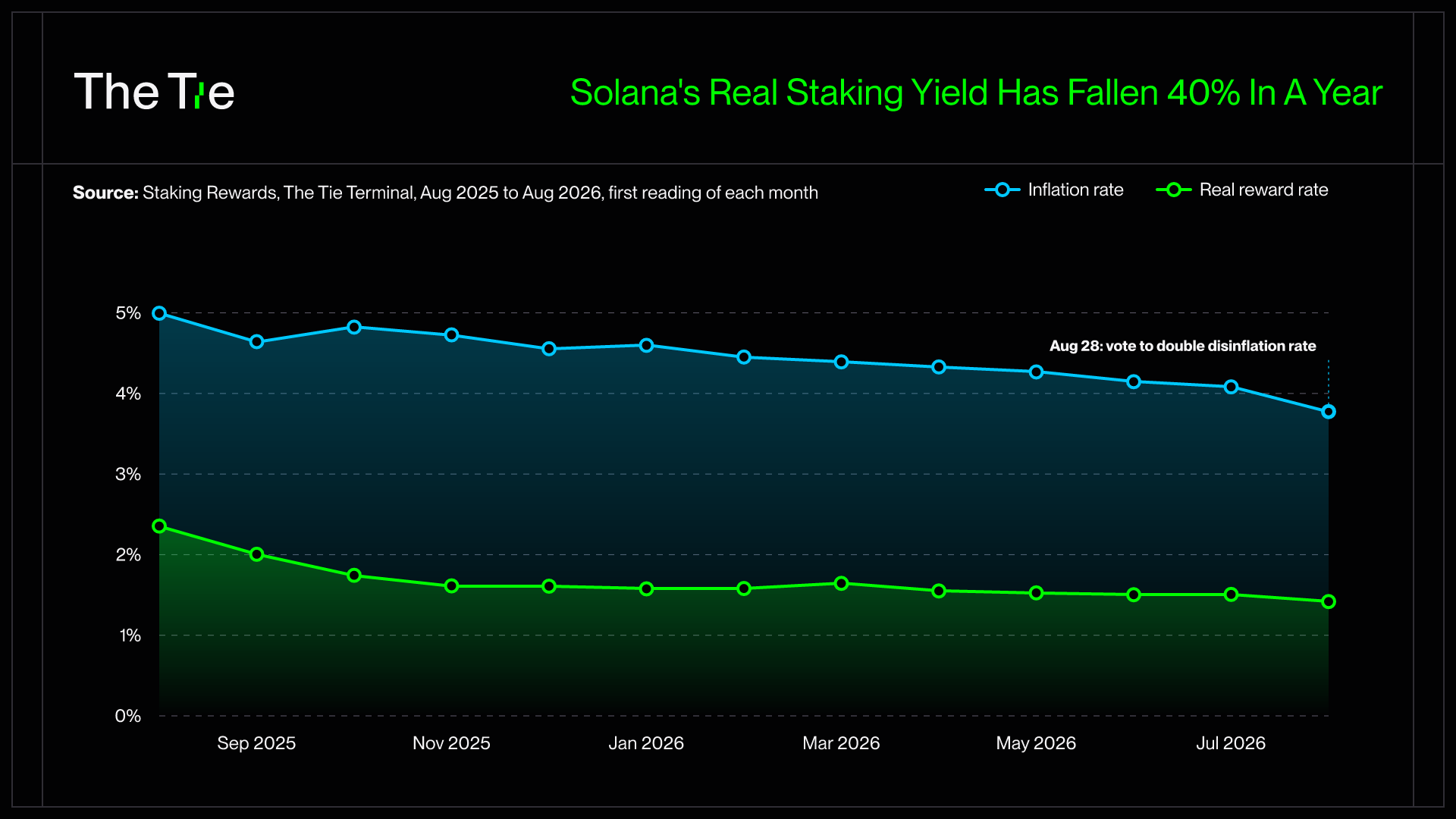
That decline was already priced into every staking product built on Solana before Friday's vote. What the vote changes is the slope, not the direction. The inflation rate fell by about a sixth over the past twelve months. Once implemented, the new schedule doubles the rate at which it falls from here, with the same 1.5% floor at the end of it.
The timing puts a specific number of institutional dollars on the other side of that slope. Bitwise's BSOL became the first Solana-focused ETF to cross $1 billion in assets under management on August 28, the same day as the vote, holding roughly 9.3 million SOL with 96% of it staked. That is a little over 2% of the 437 million SOL currently staked on the network, which The Tie's data puts at $44.4 billion in staked value. Bitwise separately reports BSOL's own staking reward rate, net of validator commission, at 5.80%, a different netting than the inflation-adjusted real rate above, and one worth keeping distinct: one number describes what the fund is paid before its own management fee, the other describes what a staker actually keeps after new issuance dilutes the position.
The honest read for an allocator is not that yield is about to collapse. It is that the yield underwriting a staking product is not a fixed input the way a bond coupon is. It is set by a stake-weighted vote, this one across roughly 1,300 validators, and it cleared by a third of a percentage point on switches that landed in the closing minutes. At today's price of about $103, Solana mints close to $2.5 billion of new SOL a year to pay for staking security. That is the pool of value every disinflation debate is actually fighting over, and it shrinks by design regardless of which schedule wins. What changed on Friday is only how fast.
One caveat belongs here. The figures above measure the inflation-funded portion of staking income, and the vote does not touch the rest of validator revenue. The two pieces behave differently for a delegator. Priority fees currently accrue to the validator with no in-protocol pass-through, though SIMD-123 is set to change that. Jito tips already flow to stakers on-chain, net of the validator's MEV commission, across the large majority of active stake. MEV is therefore closer to a like-for-like addition to the numbers above than priority fees are.
The staking data behind this, including reward, issuance and real-yield series across more than 200 launched assets, runs on Staking Rewards and through the Data APIs.